“Design Netflix”, or its plainer cousin “design a video streaming service”, is a delivery problem wearing a product’s name. Candidates lose it by spending ten minutes on sign-up, profiles and recommendations, then running out of time before the only part that is hard: getting a few megabits a second of video to tens of millions of screens at once without a stall. Netflix’s own interview round runs 60 minutes (Blind, July 2025), but most companies ask this question in 45, so that is the clock here.
The walkthrough follows the 45-minute framework: requirements, the numbers that matter, the high-level design with one play request walked through it, two deep dives, then trade-offs. The real-world references are Netflix’s own description of Open Connect, its network of caches placed inside internet providers (Netflix Open Connect), and the history of Vitess, the tool YouTube built to split its MySQL database (Vitess).
Requirements and scope (0 to 5 minutes)
Ask, write the answers on the board, and cut hard. The questions that change the design:
- Who uploads? Studios, through an internal delivery pipeline, not users. This matters more than it sounds. No user uploads means no abuse, no moderation, no surprise spikes of new video, and transcoding (converting a video into several sizes and qualities) can run as a slow batch job on a known catalogue.
- Browse and search? Yes, a catalogue with titles, episodes, artwork and descriptions.
- Play with adaptive quality? Yes, on TVs, phones and browsers, on fast and slow networks, with the quality adjusting as the connection changes.
- Resume where you left off? Yes, across devices.
- Recommendations? Out of scope unless the interviewer asks, and say so. It is a separate system, and the interviewer who wants it will ask.
- Live events, downloads, DRM (the licensing that stops copying)? Name them, mention where they attach, leave them out.
Non-functional requirements (how well the system works rather than what it does): playback should start within a couple of seconds and never stall, which is the whole game; availability beats consistency everywhere, since a watch position that is ten seconds stale is fine and a title that does not play is not.
What to say: “I will assume content comes from studios through our pipeline, that users browse, search, play and resume, and that recommendations are out of scope. The hard requirement is smooth playback at scale, so most of my time will go to encoding and delivery. Tell me if you would rather I spend it elsewhere.”
The numbers that matter (5 to 8 minutes)
Netflix reported crossing 325 million paid memberships (Netflix Q4 2025 letter). Start there, then estimate. Everything after the first number is a rule-of-thumb estimate, not a Netflix figure, and you should say that.
- Concurrent streams. Assume one in ten members is watching at the global evening peak. That is about 30 million streams at once.
- Bandwidth. Assume an average stream of 5 megabits a second, an ordinary HD figure. 30 million x 5 Mbps = 150 million Mbps, or 150 terabits a second. Nobody serves that from one data centre. The number tells you the design: the video has to come from caches close to every viewer, and the origin (the central copy) should almost never be touched during playback.
- One ISP. A provider with one million subscribers and 100,000 concurrent streams would pull 500 gigabits a second across its connection to the rest of the internet if the video came from outside. A cache inside the provider’s own network turns that into local traffic.
- Storage for one title. A two-hour film, encoded into a ladder of qualities from about 0.5 Mbps for a phone on a poor connection up to 16 Mbps for 4K, with the rungs adding up to roughly 35 Mbps in total. 35 Mbps x 7,200 seconds = 252,000 megabits, about 31 GB per video codec (the compression format). With three codecs for different devices and the audio tracks, call it 100 GB per title. A catalogue of 10,000 titles is then about 1 PB, which is small. Storage is not the problem. Delivery is.
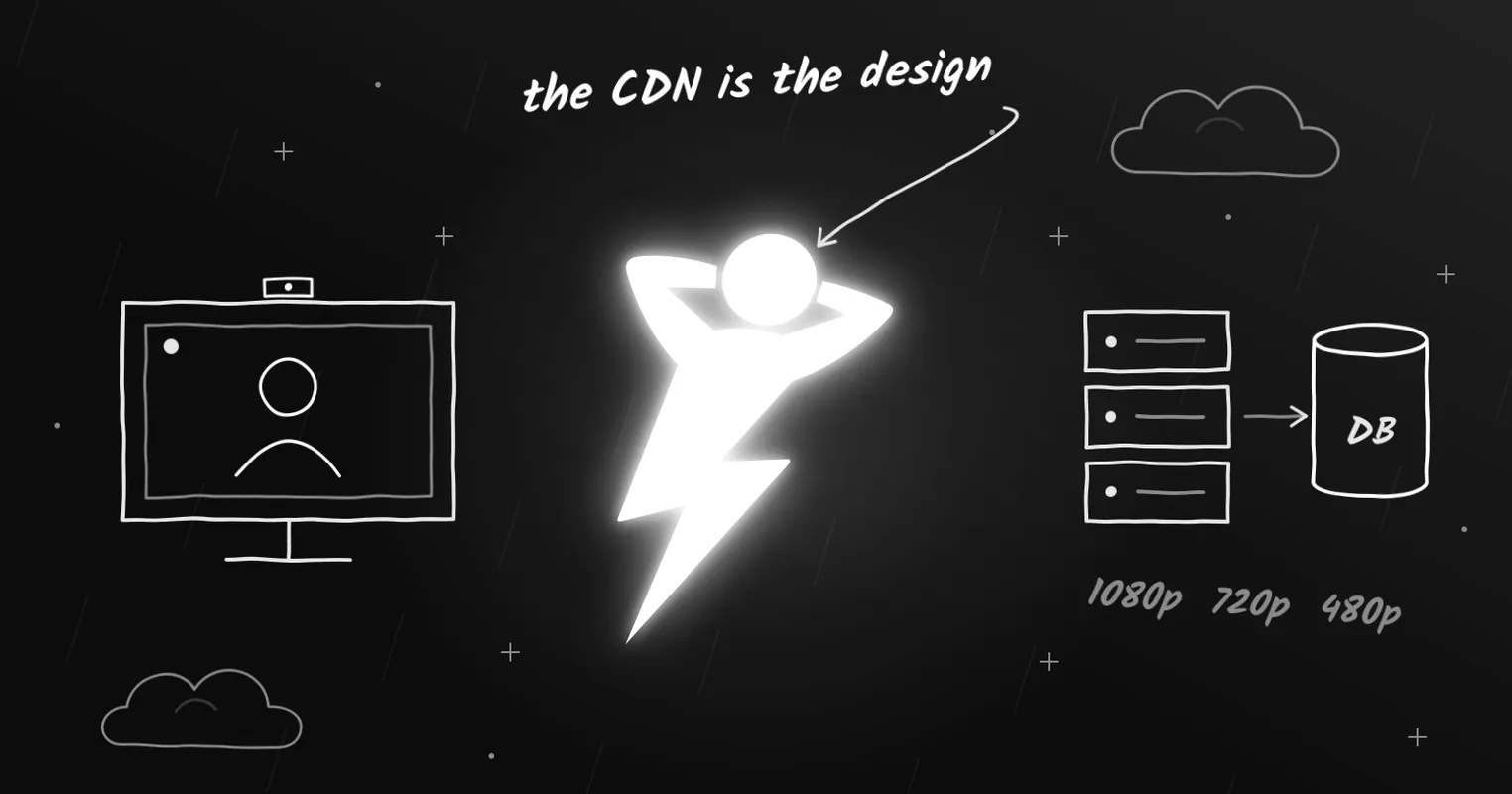
What to say: “Around 30 million concurrent streams at peak and 150 terabits a second, as a rough estimate. That rules out serving from a central origin and makes the CDN (content delivery network, the caches near viewers) the centre of the design. Storage is a petabyte scale problem, which object storage handles without much thought, so I will not spend time there.”
The back-of-the-envelope estimation guide has the constants and the habit of calculating only the numbers that pick a component. Here the bandwidth number picked the CDN and the storage number told you to skip storage.
High-level design, then walk one play request (8 to 20 minutes)
There are two systems on the board: the pipeline that prepares a title before anyone can watch it, and the playback system that serves it. Draw the pipeline first, because the interviewer is checking whether you know that video is not served the way it arrives.

The pipeline, left to right:
- Ingest. The studio delivers a master file (a very large, high-quality source) to object storage.
- Split into chunks. The master is cut into pieces a few seconds long so that many machines can encode it at the same time instead of one machine grinding through two hours.
- Transcode in parallel. Workers pull chunks from a queue and encode each one at every rung of the quality ladder: several resolutions (the frame size) and bitrates (how many bits per second of video, which sets both quality and bandwidth), in each codec the devices need.
- Package. The encoded chunks become short segments, and a manifest (a text file listing every segment at every quality) is written for each title. Apple’s HTTP Live Streaming format works this way: a playlist points at a sequence of small media files (Apple HLS). The alternative standard, DASH, has the same shape.
- Quality check and publish. Automated checks, then the title’s segments are written to origin object storage and the catalogue is told the title is ready.
- Pre-position. Popular titles are copied to the caches inside ISP networks ahead of demand, which is the first deep dive.
Now the playback side.

- Metadata service. Titles, episodes, artwork, descriptions, which encodes exist for each title. A relational database with a primary for writes and read replicas, plus a cache in front, since the catalogue changes a few thousand times a day and is read billions of times.
- Search index. Built from the metadata, updated when a title is published.
- Playback service. Called when the user presses play. It checks that the account may watch this title, picks the encodes that suit the device, issues the DRM licence, and returns the manifest URL and the hostnames of the caches nearest this viewer.
- Watch-position service. Receives a small heartbeat from the player every few seconds and stores the position in a key-value store (a database that stores one value per key with no joins), keyed by user and title.
- Open Connect caches. The CDN. Every byte of video comes from here. The origin object storage is behind it for misses.
Walk one play request through it, out loud, pointing at each box.
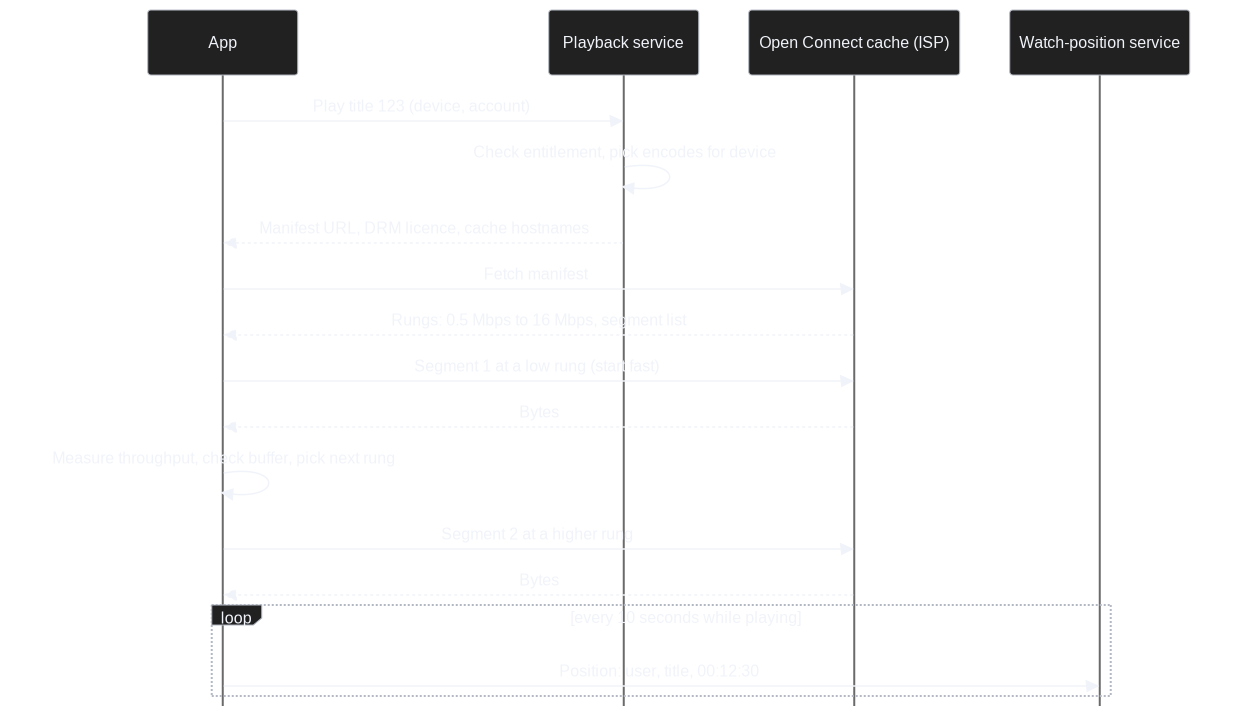
What to say: “The user presses play on title 123. The app calls the playback service with the device type and the account. The service checks the entitlement, picks the codec and the ladder for this device, issues the licence, and returns the manifest URL and the cache hostnames for this viewer’s ISP. The app fetches the manifest from the cache, then asks for the first segment at a low rung so the video starts fast. While that plays it measures how quickly the segment arrived, and asks for the next one at a higher rung. Every ten seconds it sends the current position to the watch-position service, which writes it to the key-value store under the user and title. Nothing in the play path touches the origin unless a cache misses.”
Then stop: “That is the basic design. The two places I would go deeper are delivery and the player’s quality choice. Which first?” You are at the midpoint with the whole picture on the board.
Deep dive one: delivery through caches inside the ISP (20 to 29 minutes)
Here is why the CDN is the whole design and not a box you add at the end. The latency table every candidate should know puts a round trip from California to the Netherlands at about 150 milliseconds and a round trip inside one data centre at about 500 microseconds (Jeff Dean’s numbers). Video does not care much about latency once it is playing, but it cares enormously about throughput, and the 150 terabits a second from the estimate cannot cross the internet’s long-distance links at peak every evening. It has to be served from inside the networks where the viewers are.
Netflix’s answer is Open Connect. The facts from its own description (Netflix Open Connect):
- Netflix builds its own cache servers, Open Connect Appliances, and the same hardware runs in its data centres and inside partner networks.
- Qualifying ISPs get appliances “at no charge” and embed them in their own networks, so Netflix traffic to their subscribers never leaves their network. Netflix says it works with over a thousand ISPs this way.
- ISPs that do not embed appliances connect to Netflix’s caches at internet exchange points (buildings where networks plug into each other) instead.
- The appliances are filled with content on a schedule, with a dedicated link for “nightly content fills and updates”. New appliances are pre-filled with the content that suits their region.
Explain the model in plain words: Netflix knows its whole catalogue in advance and can predict what people will watch tomorrow, so it pushes tomorrow’s popular titles to the caches tonight, when the ISP’s links are quiet. That is pre-positioning. A user-generated service like YouTube cannot do this for a video uploaded five minutes ago, which is why its CDN fills on demand (a cache fetches a video from the origin the first time someone nearby asks for it).
The request path, then: the player asks the appliance inside its ISP for a segment. Hit: served locally. Miss: the appliance fetches it from a larger Netflix cache at an exchange point, or from origin, and keeps a copy. Because of the overnight fills, the miss rate for popular content is low; the long tail of rarely watched titles is where misses happen, and that tail is small traffic by definition.
What to say: “Delivery is a push CDN. Every night we copy the titles we expect to be watched tomorrow onto caches that sit inside each ISP, so at peak the video is local traffic for the ISP and never crosses its upstream link. The ISP wins because it saves bandwidth, we win because the origin is idle during the peak. On a miss the cache pulls from a regional cache, then origin, and keeps the copy. For a service with user uploads I would do the opposite, a pull CDN that fills on first request.”
Two follow-ups the interviewer may ask. “What about a new release that everyone wants at once?” It was pushed to every cache the night before, which is the point. “What if an appliance fails?” The playback service hands the player several cache hostnames, and the player moves to the next one.
Deep dive two: the player’s quality choice, and the watch position (29 to 38 minutes)
Adaptive bitrate. The player, not the server, decides the quality of every segment. It downloads a segment, measures how fast it arrived, checks how many seconds of video it has buffered, and picks the rung for the next segment from the manifest. Too slow, and the buffer drains: step down. Plenty of headroom and a full buffer: step up. In a browser the Media Source Extensions API is what lets a script feed segments into the video element one at a time (MDN), and HLS and DASH exist so that one manifest can describe every rung (Apple HLS).

Three details show you understand it:
- Start low. The first segment is requested at a low rung so the first frame appears in well under a second, and the player climbs from there. Starting at the top quality means a long wait on a slow network.
- Short segments. A few seconds each, so a step down takes effect within one segment and a sudden drop in bandwidth causes at most a short dip in quality, not a stall.
- Hysteresis. Step down fast and step up slowly, so the quality does not flicker between rungs when bandwidth hovers near a boundary.
What to say: “Quality is chosen per segment by the player from measured throughput and buffer level. The server stays simple: it just serves files. That is why the whole system can be plain HTTP caches instead of streaming servers.”
The watch position. Small, frequent writes at a huge rate. Take the 30 million concurrent streams from the estimate, with a heartbeat every 10 seconds: 3 million writes a second, each a few dozen bytes. Reads happen when someone opens the app and sees “continue watching”, far fewer.
- Store. A key-value store partitioned by user id, with the value being the title, the position and a timestamp. These stores are built for this write shape. The Dynamo paper describes the design (Amazon, 2007), and DynamoDB served 89.2 million requests a second on Prime Day 2021 (USENIX ATC 2022), so 3 million writes a second is within what the pattern handles.
- Consistency. Eventual (replicas may disagree for a moment) is fine. Last writer wins by timestamp. The worst case is that a user who switches from TV to phone within a few seconds resumes ten seconds early. Nobody minds.
- Cut the writes. The player can batch heartbeats and send on pause, on stop, and every 30 seconds instead of every 10, which cuts the write rate by two thirds at the cost of a slightly worse resume. Say that this is a dial, not a fixed number.
What to say: “The watch position is an eventually consistent key-value write per user per title, last writer wins. I accept a ten-second stale resume in exchange for never blocking playback on a database.”
For the metadata, offer the comparison the interviewer may be looking for. Netflix’s catalogue is small and read-heavy, so a relational primary with replicas and a cache is enough. YouTube’s metadata was not: Vitess “was created in 2010 to solve the MySQL scalability challenges” at YouTube, when write traffic grew too high for one primary and the team had to shard (split the database by key across many servers) (Vitess). The lesson to state: shard when the write rate forces it, not before. Hello Interview reports more candidates down-levelled (hired a level below the one they applied for) in 2025 because of over-engineering (Hello Interview, January 2025); sharding a catalogue that fits on one box is a textbook case.
Trade-offs and what you cut (38 to 43 minutes)
Choice, cost, what was cut, what comes next. Four sentences each.
- Pre-positioning versus on-demand fill. Pushing content overnight costs disk in every ISP and the prediction can be wrong, but it keeps the origin idle at peak and gives the ISP a reason to host the cache for free. On-demand fill wastes nothing on unpopular titles but sends the first viewers of every title in every region to the origin at the worst time. For a known catalogue, push. For user uploads, pull.
- Encoding cost versus quality. Every rung, codec and audio track multiplies the one-time encoding bill, and encoding a title specially for its own content (a cartoon needs far fewer bits than an action film at the same quality, a practice called per-title encoding) costs more compute again. But encoding runs once and each title is watched millions of times, so bits saved per play repay the compute many times over. Spend on encoding.
- Strong versus eventual consistency for the watch position. Strong consistency would mean every heartbeat waits for agreement across replicas, which adds latency to 3 million writes a second for no user-visible benefit. Eventual, last writer wins.
What to say: “I chose a push CDN filled overnight, a deep encoding ladder, and an eventually consistent watch position, because every one of those spends a cheap resource, disk, compute or a few seconds of staleness, to protect the expensive one, bandwidth at peak. What I cut: recommendations, live events, downloads and DRM internals. With more time I would add a regional cache tier between the ISP appliances and origin so a miss never crosses an ocean.”
If you want to practise this summary shape on other questions, design Instagram has the opposite profile, user uploads and a pull CDN, and the 20 system design questions give the outline for each.
What the interviewer probes at each level
- Mid-level. Do you know video must be transcoded into several qualities before it is served? Can you draw the pipeline, the object storage, the CDN and the playback service, and walk one play request? Do you know what a manifest and a segment are? A complete picture with the CDN in the right place passes.
- Senior. Why the CDN is the design and not an add-on, with the bandwidth number to prove it. Push versus pull fill and when each is right. How adaptive bitrate works from the player’s side, including starting low and short segments. The write rate of the watch position and why eventual consistency is the right call. An interviewer on Blind who says they have run about a thousand rounds expects the basic design done by the midpoint (Blind AMA, June 2024); at this level the deep dives are where the time goes.
- Staff. The economics: what pre-positioning costs the ISP and Netflix, and why both agree to it. Encoding cost against bandwidth saved across the catalogue’s lifetime. Failure modes: an appliance dies, a region’s exchange point is congested, a new release is more popular than predicted. And a decision on every one. Hello Interview’s staff guide names listing options without choosing as the most common failure (Hello Interview).
Before the round, the system design cheat sheet is the one-page reminder of the latency numbers, the building blocks and the trade-off phrases used above.
How InterviewStorm helps
Use InterviewStorm as a practice partner for this round. Describe the question in a mock call and it returns the full shape of a strong answer: the requirements to pin down, the numbers that decide the design, an architecture diagram it draws itself, the play request traced through the pipeline and the caches, the schema and the APIs, the scaling moves and the trade-offs, so you can rehearse the 45 minutes out loud and check your board against a complete one. See the system design feature.
Most companies do not allow AI help in the design round itself, and interviewers say they watch for it. Use it live only where the employer allows it, and to practise everywhere else. Follow each employer’s interview rules. Do not use InterviewStorm in proctored tests, exams, or anywhere AI help is not allowed.
The free trial is 20 minutes in total, up to 15 minutes per session, with no credit card. Try it free.
For the rest of the loop, read the guides on coding interviews and the STAR method.
Share Articles:
Similar Posts