20 System Design Interview Questions With Answer Outlines (2026)
- Andrew C. Lewis
- 12 Nov, 2026
- 16 Mins read
System design interview questions repeat. The wording changes (“design Twitter”, “design a news feed”, “design a timeline”), but the twenty systems below cover almost every prompt you will meet in a 45-minute round, from a URL shortener at the junior level to an agent orchestration system in Meta’s AI-focused design round.
Each question has the same five lines: what it tests, the two clarifying questions to ask, the one number that matters, a four-line answer outline (data flow, storage, the scaling move, the deep dive), and the trade-off to name out loud. The numbers come from the companies that run these systems, with sources, so you can say them in the room. For pacing the 45 minutes, use the system design interview framework; this page is the content to pour into it.
The outlines are the simplest design that meets the scope, on purpose. Hello Interview names over-engineering as the usual cause of candidates being down-levelled (hired one level below the level they applied for) (Hello Interview, January 2025). Start with the outline, then let the interviewer pull you deeper.
Junior level
Junior questions test whether you can turn a vague prompt into a few boxes and walk one request through them. If you are early in your career, system design for junior engineers explains what you are allowed not to know.
1. Design a URL shortener
- Tests: a tiny read-heavy system end to end, with one hard choice: how to make unique short codes.
- Ask: “How many new links a day, and how long do they live?” and “Do we need click analytics, or just the redirect?”
- The number: seven base62 characters (digits plus upper and lower case letters) give 62 to the power 7, about 3.5 trillion codes. The key space is never the problem; the id generator is.
- Outline: the client posts a long URL, the service makes a short code and stores the pair; a redirect reads the code and returns the long URL. Storage: a key-value table with hot codes in a Redis cache (an in-memory store). Scaling move: cache the popular codes and add read replicas, since reads dominate. Deep dive: unique ids. A base62 counter is simplest; at scale, Snowflake-style ids pack a 41-bit timestamp, a 10-bit machine id and a 12-bit sequence into one number, so servers mint ids without coordination (Twitter Snowflake).
- Trade-off: a 301 redirect is cached by the browser, so later clicks never reach you and you lose the count; a 302 is not cached, so you see every click and pay for every request (MDN).

2. Design a rate limiter
- Tests: whether you know one algorithm well and can say where the counters live.
- Ask: “Per user, per API key or per IP address?” and “Is a small overshoot at the window boundary acceptable?”
- The number: Cloudflare’s sliding window approximation misclassified only 0.003% of 400 million requests, the argument for the cheap algorithm over an exact one (Cloudflare, 2017).
- Outline: each request hits the limiter first; it updates a counter for the caller and returns allow or reject (HTTP 429). Storage: counters in Redis, keyed by caller and window. Scaling move: run the check in the API gateway and shard counters by caller. Deep dive: token bucket (each caller gets tokens that refill at a fixed rate; a request spends one; no tokens means rejected), which Stripe runs in Redis (Stripe, 2017).
- Trade-off: one central counter is exact but adds a network hop to every request; a counter per server is fast but lets a caller exceed the limit by the number of servers.
Full walkthrough, with four algorithms and distributed counters: design a rate limiter.
3. Design typeahead (search suggestions)
- Tests: latency thinking and the right data structure.
- Ask: “Suggestions from a fixed dictionary, or from live searches?” and “Personalised, or the same for everyone?”
- The number: Facebook’s typeahead team treated any result slower than 100 ms as wrong, because the user has already typed the next letter (Facebook Engineering, 2010).
- Outline: every keystroke calls a suggestion service that returns the top completions for the prefix. Storage: a trie (a tree where each path spells a prefix) with the top completions cached at each node, in memory. Scaling move: shard the trie by first letters and cache the hottest prefixes near the user. Deep dive: rebuild the trie from query counts in a batch job, and swap it in when ready.
- Trade-off: offline rebuilds keep reads fast but suggestions lag by hours; live counting is fresh but makes every search a write to a hot structure.
4. Design a notification system
- Tests: queues, workers and reliability, the pattern one interviewer calls the biggest gap in candidates’ answers (Hacker News, January 2026).
- Ask: “Which channels: push, email, SMS, in-app?” and “Which is worse, a lost notification or a duplicate?”
- The number: Uber’s push platform handles 250,000 messages a second over 1.5 million open connections; before it existed, polling was 80% of gateway traffic (Uber Engineering, 2020).
- Outline: internal services post to a notification API, which checks preferences and drops the message on a queue; workers per channel pull and call the provider. Storage: a preferences table and a delivery log, one row per attempt. Scaling move: one queue topic and worker pool per channel, so a slow SMS provider never blocks push. Deep dive: at-least-once delivery (a message leaves the queue only after the provider accepts it) plus a dedupe check on the notification id in Redis.
- Trade-off: at-least-once never loses a message but can duplicate one; exactly-once through a third-party provider cannot be promised, so say which side you pick.
Worked minute by minute in the framework post.
5. Design a key-value cache
- Tests: memory, eviction and what a cache cannot do.
- Ask: “What hit rate do we need, and what happens on a miss?” and “Can the cache lose data on restart?”
- The number: one Redis instance does about 180,000 SET operations a second without pipelining, and a 4 KB value at 100,000 requests a second needs 3.2 Gbit/s, so the network card limits you before the CPU (Redis benchmarks).
- Outline: clients hash the key to a node and send get or set; the node keeps a hash map in memory. Storage: memory only, with an optional append-only log for restarts. Scaling move: consistent hashing (assigning keys to nodes so that adding a node moves only a small share of keys) (Wikipedia). Deep dive: eviction. Least-recently-used with a TTL (time to live, the seconds a value stays valid), plus leases so a thousand clients missing the same key do not all hit the database (NSDI 2013).
- Trade-off: cache-aside (read the cache, on a miss read the database and fill the cache) is simple but serves stale data until the TTL ends; write-through stays fresh and makes every write slower (AWS caching strategies).
Mid level
Mid-level questions add one hard sub-problem: fan-out, ordering, sync, politeness, geography or contention. The interviewer wants the simple design in ten minutes, then twenty minutes inside that sub-problem.
6. Design a news feed
- Tests: the fan-out decision, and handling the celebrity case without redrawing.
- Ask: “How many followers does a typical user have, and the maximum?” and “Newest first, or ranked?”
- The number: Twitter served about 300,000 home timeline reads a second against about 5,000 new tweets a second, and capped each cached timeline at 800 entries (Raffi Krikorian, QCon 2012).
- Outline: a post is written once, then fan-out workers push its id into each follower’s feed cache; opening the feed reads one cached list and loads the posts. Storage: posts in a database, feed lists of post ids in Redis. Scaling move: a queue between the post write and the fan-out, so a million followers do not stall the request. Deep dive: the hybrid. Fan out on write for normal users, skip it for celebrities and merge their latest posts in at read time.
- Trade-off: fan-out on write gives instant reads but copies every post many times; fan-out on read is cheap to write but slow to open. Say where you draw the line.

Photo version, with the storage math: design Instagram.
7. Design a chat app
- Tests: real-time delivery, ordering and offline users.
- Ask: “One-to-one only, or group chats?” and “Do we need delivered and read receipts?”
- The number: Slack targets 500 ms delivery anywhere in the world, with channel servers on a consistent hash ring holding about 16 million channels per host at peak (Slack Engineering, 2023).
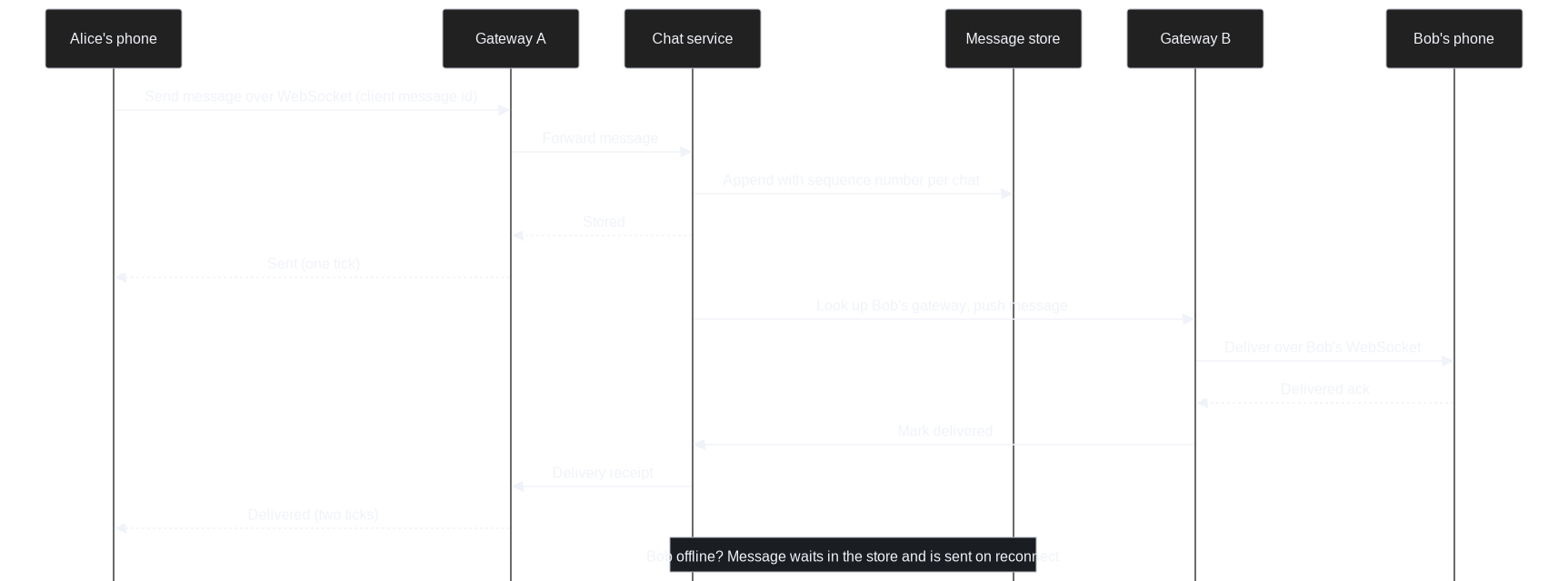
- Outline: each phone keeps one WebSocket (a connection that stays open so the server can push) to a gateway; a message goes gateway, chat service, store, then out through the recipient’s gateway. Storage: messages keyed by chat id plus a time bucket, which is how Discord stores trillions of them (Discord, 2023). Scaling move: a registry of which gateway each user is on. Deep dive: a sequence number per chat so clients can order messages and ask for gaps.
- Trade-off: storing before delivering loses nothing but adds a database write to the latency path; delivering first is faster and can lose a message if the server dies in between.
8. Design file sync (Dropbox)
- Tests: large uploads, deduplication and conflicts.
- Ask: “Typical file size, and the largest?” and “What happens when two devices edit the same file offline?”
- The number: Dropbox splits files into 4 MB blocks and syncs a list of SHA-256 hashes (a fingerprint of each block), so a one-line edit uploads one block, not the file (Dropbox, 2014).
- Outline: the client hashes blocks, asks which hashes are new, uploads only those, then commits a new file version. Storage: blocks in object storage (a service that stores files by name, like S3), metadata in a database. Scaling move: a notification channel so other devices learn about the change instead of polling. Deep dive: conflicts. Keep both versions, name one “conflicted copy”, never merge silently.
- Trade-off: small blocks mean less upload on edits but more metadata rows; big blocks are the reverse.
9. Design a web crawler
- Tests: queues at scale, politeness and deduplication.
- Ask: “How many pages, and how fresh?” and “Do we run JavaScript, or fetch raw HTML?”
- The number: a month is about 2.5 million seconds, so a billion pages a month is about 400 fetches a second. The per-host politeness limit, not the fetch rate, shapes the design.
- Outline: seed URLs go into a frontier (the queue of URLs to visit); workers fetch, parse, extract links and push new URLs back. Storage: page content in object storage, the seen-URL set and frontier in a database or queue. Scaling move: partition the frontier by host so one worker owns each host and respects its crawl delay (Mercator, 1999). Deep dive: the content-seen test. Hash the body and skip duplicates, with a Bloom filter (a tiny structure that answers “definitely not seen” or “probably seen”) in front of the big set (Wikipedia).
- Trade-off: a Bloom filter saves memory but sometimes says “seen” for a new page, so a few pages are skipped; an exact set never skips and costs far more memory.
10. Design nearby places search
- Tests: spatial indexing and read-path latency.
- Ask: “How often do places move?” and “Radius only, or ranked by rating too?”
- The number: a geohash (a string that names a map cell; longer strings mean smaller cells) of 6 characters is accurate to about 0.61 km, 5 characters to about 2.4 km (Wikipedia). That picks your prefix length.
- Outline: a query carries a latitude and longitude; the service computes the geohash, fetches places in that cell and its eight neighbours, filters by distance, returns a page. Storage: a places table with an indexed geohash column, or Redis GEO (Redis). Scaling move: cache results per cell, since places rarely move. Deep dive: a quadtree (a tree that splits the map into four smaller squares until each holds few points) when density varies a lot (Wikipedia).
- Trade-off: geohash works in any database but a search near a cell edge needs neighbour lookups; a quadtree adapts to density but is harder to keep in sync.
11. Design ticket booking
- Tests: contention (many people wanting the same seat) and double booking.
- Ask: “How long does a seat hold last?” and “Is a short wait acceptable when a big sale opens?”
- The number: Ticketmaster saw 3.5 billion requests during one presale, four times its previous peak (Ticketmaster, November 2022). The opening minute, not the normal day, is the design input.
- Outline: the user picks a seat, the service places a timed hold, payment confirms, the hold becomes a booking. Storage: a seats table with a status and hold expiry; the booking in the same transaction as the status change. Scaling move: a virtual waiting room that admits users in batches the database can handle, as in Ticketmaster’s Smart Queue (Ticketmaster). Deep dive: the hold. An atomic update (“set status to held where status is free”) plus a job that frees expired holds.
- Trade-off: a waiting room keeps the system up but makes fans watch a counter; letting everyone in at once is fairer in theory and falls over in practice.
Senior level
Senior questions have no single hard part. They test whether you pick the two that matter, go deep, and name what you cut. The cheat sheet lists the building blocks these answers assume.
12. Design video streaming (Netflix)
- Tests: a heavy upload pipeline next to a massive read path.
- Ask: “Uploads from a few studios, or from every user?” and “Live, or on demand?”
- The number: Netflix passed 325 million paid memberships (Netflix Q4 2025 letter) and serves video from Open Connect, its own caches inside internet providers’ networks, filled at night (Netflix Open Connect). Bandwidth, not requests, is the number.
- Outline: upload to object storage, then a pipeline transcodes each title into several bitrates and chunks; playback fetches a manifest, then chunks from the CDN. Storage: raw and transcoded files in object storage, titles and progress in a database. Scaling move: the CDN carries almost all bytes; the origin serves manifests and misses. Deep dive: adaptive bitrate, where the player picks the next chunk’s quality from measured bandwidth.
- Trade-off: pre-transcoding every bitrate costs storage and compute up front; transcoding on demand saves both and adds minutes before the first play.
Full answer with numbers and diagrams: design Netflix.
13. Design ride matching (Uber)
- Tests: a write-heavy location stream and matching under latency pressure.
- Ask: “How often does a driver report location?” and “Match by distance, or by estimated time of arrival?”
- The number: Uber had 189 million monthly users and 3.5 billion trips in one quarter, about 38 million a day (Uber Q3 2025). Driver location writes, not trips, dominate.
- Outline: drivers push location every few seconds over a WebSocket; a location service writes it to an in-memory spatial index; a rider request finds nearby drivers, ranks them, and offers the trip. Storage: locations in memory keyed by map cell, trips in a database. Scaling move: shard the index by region using S2 cells, as Uber did (High Scalability, 2015). Deep dive: match by ETA on the road network, not straight-line distance; a driver across a river is far away.
- Trade-off: more frequent location updates give better matches and cost more writes; say the interval you pick and why.
14. Design a payment system
- Tests: correctness under retries and failures, with money on the line.
- Ask: “Do we hold the money, or pass it to a card processor?” and “What must never happen: a double charge, or a missed one?”
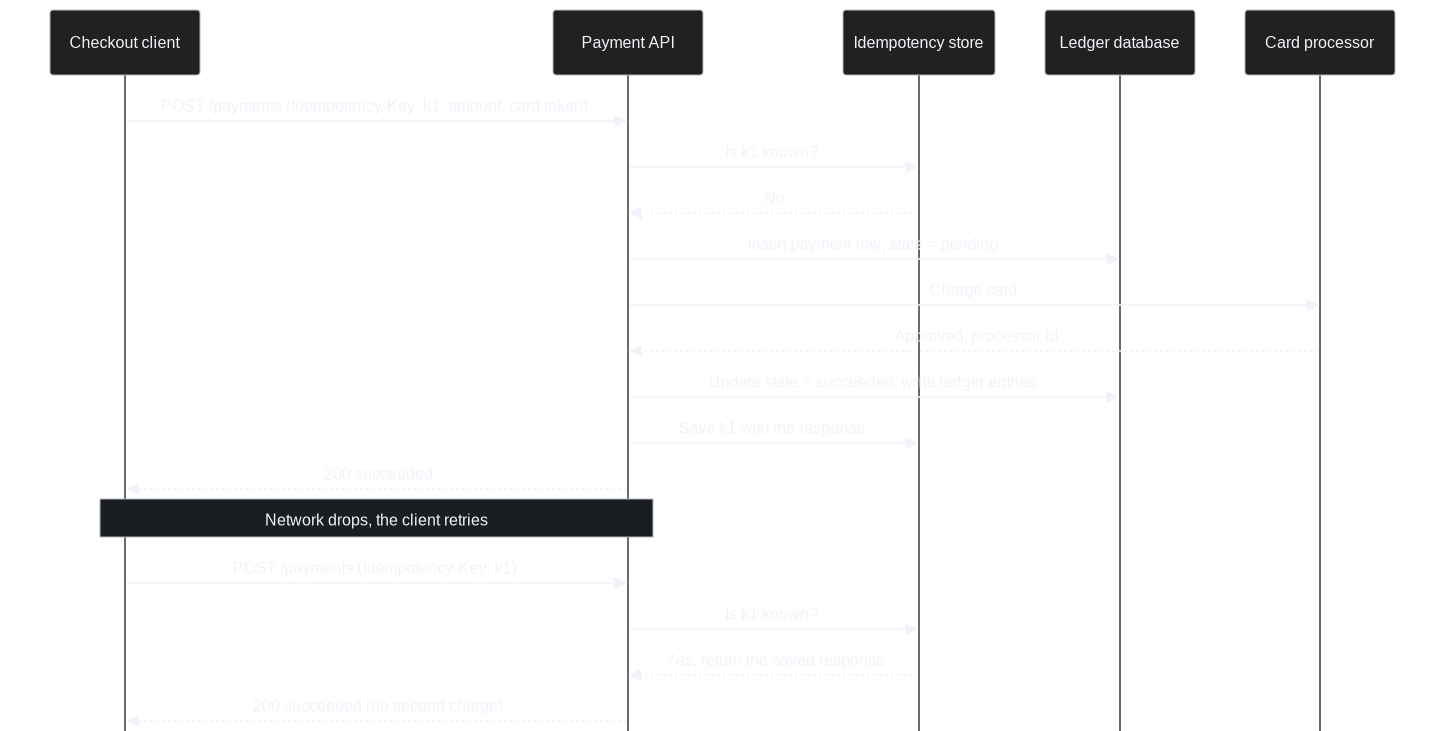
- The number: Stripe keeps idempotency keys for at least 24 hours, so a retry inside that window returns the original result instead of charging twice (Stripe API docs).
- Outline: the client sends a payment with an idempotency key (a unique id for this one attempt); the service records a pending row, calls the processor, marks the result and writes ledger entries. Storage: a double-entry ledger (every amount appears twice, as a debit and a credit, so the books always balance) in a transactional database. Scaling move: a queue for webhooks and retries, so processor callbacks never block. Deep dive: the state machine and the idempotency store, the problem Airbnb built its payments platform around (Airbnb Engineering, 2019).
- Trade-off: strong consistency on the ledger means lower throughput and a single primary. Right call here; say why you refuse eventual consistency for money.
Ledger, webhooks and reconciliation: design a payment system.
15. Design a distributed message queue (Kafka)
- Tests: whether you understand the thing you keep drawing as a box.
- Ask: “Must consumers see messages in order?” and “Can a consumer re-read old messages?”
- The number: one Kafka broker sustains about 200 MB/s with a p99 latency of 5 ms (Confluent, 2020).
- Outline: producers append to a topic split into partitions; each partition is an ordered log on disk; consumers read from an offset they control. Storage: append-only log files per partition, replicated to other brokers. Scaling move: more partitions, each owned by one broker, with a consumer group reading in parallel. Deep dive: ordering is per partition only, and replay works because the log is kept for a retention period, not deleted on read (Kafka introduction).
- Trade-off: a partition key keeps related messages in order but makes a hot key a hot partition; random partitioning spreads load and loses order.
16. Design ad click aggregation
- Tests: stream processing and the exactly-once question.
- Ask: “How late may a count be?” and “Does a double-counted click cost us money?”
- The number: Uber aggregates ad events into one-minute windows with exactly-once processing across Kafka, Flink and Pinot (Uber Engineering, 2021). One minute is the usual answer to “how fresh”.
- Outline: click events land in a stream; a processor groups them by ad id and minute and writes counts to a store; a query service serves dashboards. Storage: raw events kept in the stream for replay, aggregates in a database built for fast queries. Scaling move: partition the stream by ad id so one processor owns each ad’s counts. Deep dive: late and duplicate events. Deduplicate by click id inside the window; let a nightly batch recompute from raw events and overwrite.
- Trade-off: exactly-once in the stream costs throughput and complexity; at-least-once with a nightly correction is cheaper and fine when the dashboard is not the invoice.
Staff level and AI systems
Staff questions are rarely new systems. They are the same systems with the interviewer asking “why that, and what breaks”. The biggest staff mistake is listing options and refusing to choose (Hello Interview). The AI questions are new: Meta runs a 45-minute “AI-Enabled design interview”, and an employee there says to prepare retrieval pipelines, agent orchestration with tool use, evals and safety guardrails (Blind, May 2026). Both AI questions get a full treatment in AI system design interview questions.
17. Design a key-value store (Dynamo)
- Tests: replication, consistency and what happens when a node dies.
- Ask: “Strong consistency on reads, or is a stale read acceptable?” and “What is the write to read ratio?”
- The number: DynamoDB served 89.2 million requests a second at its 2021 peak (USENIX ATC 2022). The design comes from the Dynamo paper (Amazon, 2007).
- Outline: a key is hashed onto a ring; the next N nodes hold copies; a write succeeds after W replies, a read after R. Storage: each node keeps a local store plus a commit log. Scaling move: consistent hashing with virtual nodes, so adding a machine moves a small share of keys. Deep dive: the quorum. With N equal to 3, W plus R greater than 3 gives a read that sees the latest write; vector clocks or last-writer-wins settle conflicts.
- Trade-off: this is the CAP choice out loud (under a network split you keep availability or consistency, not both, per Brewer). Dynamo picks availability; say when you would not.
18. Design a global rate-limited API gateway
- Tests: the rate limiter again, now across continents, which turns it into a consistency problem.
- Ask: “Is the limit per region or global?” and “How far over the limit may a caller get during a region outage?”
- The number: a round trip inside one datacenter is about 500 µs; California to the Netherlands and back is about 150 ms (Jeff Dean’s numbers). A global counter checked on every request would add 150 ms to each call.
- Outline: each region runs its own gateway with local counters; regions exchange counts asynchronously; the limit is enforced on the local view. Storage: Redis per region. Scaling move: route each caller to a home region so most of its traffic hits one counter. Deep dive: Cloudflare’s sliding window approximation, which needs two counters per key and no per-request timestamps (Cloudflare, 2017).
- Trade-off: local counters are fast and let a caller exceed the global limit by a bounded amount during sync lag; a global counter is exact and slow.
19. Design an LLM chat assistant with retrieval
- Tests: designing around a slow, expensive, non-deterministic component (a large language model, the AI that generates text).
- Ask: “Answers from the model’s own knowledge, or grounded in our documents?” and “How fresh must the documents be?”
- The number: the retrieval hop is a same-datacenter round trip, about 500 µs (Jeff Dean’s numbers); the model’s generation takes seconds. So the design works on the model call: stream it and cache it.
- Outline: documents are split into chunks, embedded (turned into vectors, lists of numbers that capture meaning) and stored in a vector index; a question is embedded, the nearest chunks are fetched, and the model answers from them (Lewis et al., 2020). Storage: the vector index, the conversation history, a cache of repeated answers. Scaling move: stream the output over server-sent events so the first words arrive before the last are generated (Anthropic streaming docs). Deep dive: evals (a test set of questions with known good answers, run on every change) and a guardrail that checks the answer cites a retrieved chunk.
- Trade-off: more chunks in the prompt give better answers and cost more tokens and time; fewer chunks are cheap and fast and miss things.

20. Design an agent orchestration system
- Tests: control flow, tool safety and cost when the model decides what happens next.
- Ask: “Is the sequence of steps fixed, or does the model choose it?” and “Which tools change the real world, and who approves those calls?”
- The number: no public benchmark fits every agent, so use a rule of thumb: each step is a full model call, so cost and latency grow with the step count, and the step cap is a design decision.
- Outline: an orchestrator receives a task, calls the model with the task and the tool list, runs the tool the model asks for, appends the result, and loops until the model says done. Storage: a run log with every step, so a run can be resumed or audited. Scaling move: orchestrator-workers, where one model splits the task into sub-tasks that run in parallel (Anthropic, December 2024). Deep dive: guardrails. A step limit, a budget per run, read-only tools by default, and a human approval gate before any tool that sends money or messages.
- Trade-off: a fixed workflow is predictable and testable; an agent that picks its own steps handles open-ended tasks and is harder to bound.
What interviewers grade
The rubric is more public than candidates think. Meta grades four things in both of its design formats: problem navigation, solution design, technical excellence and technical communication (Hello Interview Meta guide). Meta’s own page adds “drive the discussion” and “identify your focus” (Meta careers). Amazon lists six qualities: practicality, accuracy, efficiency, reliability, optimization and scalability (amazon.jobs).
The five lines above map onto Meta’s four:
- Problem navigation is the two clarifying questions and the number that matters. An interviewer who says they have run about a thousand rounds wants the basic design done after about 40% of the time (Blind AMA, June 2024).
- Solution design is the outline, drawn and walked through with one request.
- Technical excellence is the deep dive, where the sourced number and the named pattern come out.
- Technical communication is the trade-off said out loud. Naming a cache without its pattern and its cost failed a senior round at Rippling (Blind, September 2025).
If a past rejection said “required too much hinting” or “too high level”, why candidates fail system design interviews decodes each phrase and rewrites the failing answer. If you are interviewing at Meta, check which of its two formats you have in product design versus system design interviews.
How InterviewStorm helps
InterviewStorm is a practice partner for every question on this page. Say the prompt in a mock call and it gives back the requirements to clarify, the number that matters, an architecture diagram it draws itself, the request flow, the schema and APIs, the scaling moves and the trade-offs to name, so you can compare your outline with a complete one and rehearse the deep dive out loud. See the system design feature.
Most companies do not allow AI help in the design round itself, and interviewers say they watch for it; the current rules are in can you use AI in a system design interview. Use it live only where the employer allows it, and to practise everywhere else. Follow each employer’s interview rules. Do not use InterviewStorm in proctored tests, exams, or anywhere AI help is not allowed.
The free trial is 20 minutes in total, up to 15 minutes per session, with no credit card. Try it free.
For the rest of the loop, read the guides on coding interviews and the STAR method.
Share Articles:
Similar Posts