Can You Use AI in a System Design Interview? What Companies Say
- Andrew C. Lewis
- 12 Nov, 2026
- 10 Mins read
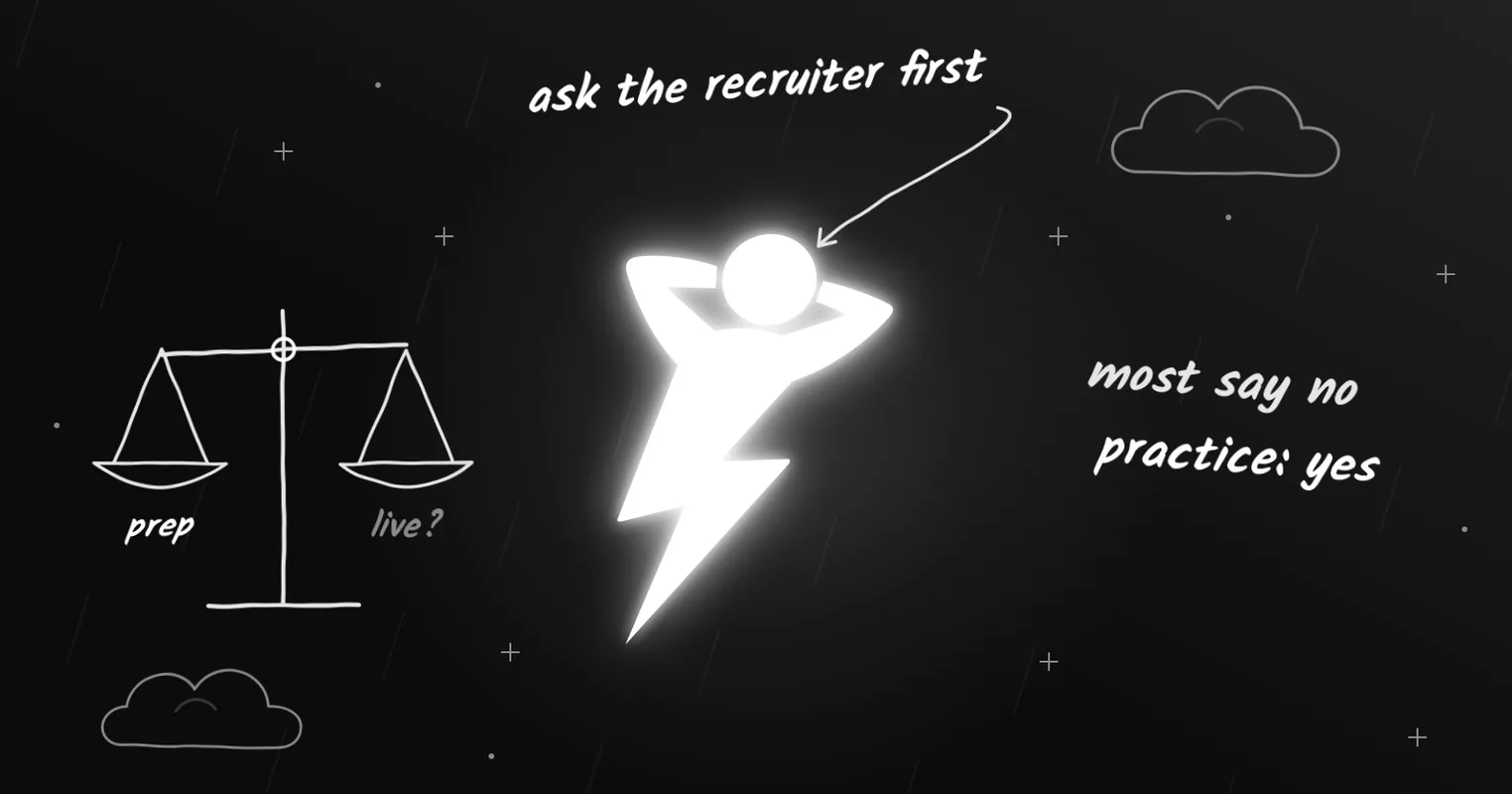
The short answer: in most system design rounds, no. The default rule is the one a candidate described in a late-2025 Ask HN thread on what tech interviews look like now: for the design round, “no AI or Googling” (Hacker News, November 2025). Interviewers say they watch for it, a survey of interviewers says most have suspected it, and at least one large company has told recruiters to disqualify candidates caught doing it.
There is one well-documented exception, a Meta round where an AI sidebar is allowed for research only, and the second half of this post is about the useful question: how to use AI before the interview instead of during it. But the rules first, company by company, with dates, because this is an area where advice goes stale in months and where guessing wrong costs you the round.
What the default looks like in 2025 and 2026
The candidate who started the Ask HN thread listed their previous loop: a recruiter screen, a live coding or take-home round, a system design round, a behavioral round. For the coding round: “No AI or Googling allowed”. For the design round: “Again, no AI or Googling” (Hacker News, November 2025). A commenter in the same thread sums up the spread: most companies “either ignore LLM usage completely or try to forbid it”. Another says they had interviews the previous year that insisted on using LLMs (large language models, the kind behind chat assistants) and others that tolerated it. So the range exists. The middle of it, for design rounds, is still “no”.
The survey evidence points the same way. interviewing.io asked 67 interviewers, 52 of them at FAANG companies (Meta, Amazon, Apple, Netflix, Google), about AI in their interviews. 81% of the FAANG interviewers said they had suspected a candidate of using AI. About a third said they had caught someone. Only 11% said their company used monitoring tools, and nearly all of those worked at Meta. 58% said they had changed the kinds of questions they ask, toward variants and more open-ended problems (interviewing.io, 2025). Read that as a design candidate: the interviewer across from you probably assumes some candidates are doing it, is probably not using software to detect it, and is probably asking a question shaped to make it less useful.
What interviewers say they notice
A system design interviewer who wrote up a year of running the round in December 2025 describes seeing, in a candidate’s glasses, the reflection of them switching between a chat window and the shared drawing board. Barker’s line: “Your glasses betray you.” The objection is not only the rule. A candidate who recites a model’s answer, Barker writes, signals that they “likely won’t come up with novel solutions”, which is the thing the round exists to find out. Barker would rather hear “I don’t know, yet” (Calvin Barker, December 2025).
That matches how the design round is built. It is 45 minutes of talking while drawing, with the interviewer changing the question as you go. The framework post covers the clock; the mistakes post covers the feedback phrases. One of those phrases, “required too much hinting”, shows up in rejections from candidates who waited for the interviewer to lead (Blind, April 2025). A candidate reading answers from a second window produces the same pattern from the other direction: pauses before each step, answers that do not match the drawing, no reaction when the interviewer adds a requirement. Interviewers have seen a lot of that pattern, and they grade it the same way whether or not they can prove the cause.
Company by company
Everything below is what a source said on a date. Rules change, and the recruiter for your loop is the only person who can tell you the rule for your round. Treat this as the list of questions to ask them.
Amazon
In July 2025, Business Insider reported that Amazon had told its internal recruiters to “disqualify job applicants who are found to have used an AI tool” during interviews (Business Insider via AOL, July 2025). Amazon’s own prep page for software engineers describes the design round inside 55-minute interviews that also hold leadership questions, and grades it on practicality, accuracy, efficiency, reliability, optimization and scalability (amazon.jobs). Nothing on that page offers an AI tool. Assume none.
Anthropic
A May 2026 LeadDev piece on the state of the technical interview reports that some companies, “even the AI company Anthropic”, are opting for no AI and want to test raw ability (LeadDev, May 2026). The same piece lists Nvidia as still asking data structures and algorithms questions, and describes Cursor giving final-round candidates its codebase to find and fix something useful over a day or two. The pattern across the piece: startups are changing faster than large companies, and “no AI in the room” remains common even at companies that build AI.
Meta: the one documented “yes”, and what it actually allows
Meta is the company whose rules matter most here, because it is the one with a design round that allows an AI tool, and the one most likely to be misquoted.
The AI-Enabled design interview. A May 2026 Blind thread quotes Meta’s careers page: the round “is a 45-minute interview” on agentic and AI systems, covering scalability, safety and evaluation. An AI assistant is available in the round for “ideating, researching, and brainstorming”, and the same page warns that candidates “should not over-rely on using the AI assistant”. A Meta employee in the thread says the sidebar is for brainstorming and research during the discussion, not for generating the answer, and lists what to prepare: RAG pipelines, agent orchestration with tool use, evals and safety guardrails (Blind, May 2026). The AI system design questions post works three of those topics in the 45-minute shape.
The AI-assisted coding interview. This is a coding round, not a design round, but it is the one people mean when they say “Meta allows AI now”. interviewing.io’s guide to it describes a 60-minute round that replaces one of the two onsite coding rounds, with an AI assistant built into the coding environment and several models to choose from. Meta’s own materials, as quoted there, say AI use is “optional and will have no bearing on the outcome”, and the guide’s advice is to use the assistant for well-defined subtasks such as boilerplate and test cases, to review its output critically, to explain to the interviewer what you used it for, and to keep ownership of the solution (interviewing.io). Business Insider’s July 2025 report on the same round quotes an internal Meta post saying the company is focused on using AI to help engineers with their day-to-day work (Business Insider via AOL, July 2025).
Meta’s classic design rounds. Meta still runs its two standard design formats, System Design for infrastructure and Product Architecture for product roles, in 45 minutes on a shared drawing board (Hello Interview Meta guide). Nothing in the sources above says an AI sidebar is available in those. The product design versus system design post covers the two formats. Unless your invite names the AI-Enabled round, assume the classic rule.
Everyone else
For companies not listed, the sources only support the default. The interviewers in the survey were at FAANG and FAANG-adjacent companies and startups, and the majority view was suspicion, not permission. The Ask HN thread’s “no AI or Googling” was posted as the normal case. If a company allows AI in a design round, it will say so in the invite, because allowing it changes how the round is graded and the interviewer needs you to know.
What “allowed” looks like when it is allowed
In the one documented case, the permission is narrow:
- A sidebar for looking things up. The Meta employee’s description is research and brainstorming during the discussion. Think “what is the default replication setting in this database” or “remind me of the trade-offs of consistent hashing”, not “design this for me”.
- The candidate still owns the design. The careers page text warns against over-relying on the assistant. The coding-round guide’s advice carries over: say out loud what you looked up and why, and be ready to defend every box on the board without the sidebar.
- It is graded. In the coding round, interviewing.io says interviewers are evaluating how well you use the tool. A candidate who pastes the whole prompt into the sidebar and reads back the result is demonstrating the opposite of the skill being tested.
A useful test for any round where a tool is allowed: if the sidebar disappeared at minute 20, could you finish? If not, you were not using it for research.
What happens if you are caught
The sources describe two outcomes, and this post will not speculate past them.
- Disqualification. Amazon’s instruction to recruiters, as reported in July 2025, was to disqualify applicants found to have used an AI tool (Business Insider via AOL, July 2025).
- A failed round. About a third of the FAANG interviewers surveyed said they had caught a candidate (interviewing.io, 2025), and the interviewer who described the reflection in a candidate’s glasses describes the effect on the assessment, not a procedure (Calvin Barker, December 2025).
There is a quieter cost that needs no source. The design round is where the interviewer decides your level. Hello Interview reported more candidates being hired one level below the one they applied for in 2025 (Hello Interview, January 2025). A candidate reading a generic answer from a second window gives a generic, over-built design, and generic over-built designs are exactly what gets down-levelled. Even when nobody notices the window, the answer it produces is the kind that loses.
Before the round: find out the rule
Do not guess. The rule is set per company and sometimes per round, and recruiters answer this question every week.

The checklist, in the order to run it:
- Read the invite. A round that allows a tool names it, as Meta’s AI-Enabled round does. No mention means no tool.
- Ask the recruiter in writing. One sentence: “For the system design round, is any AI assistant or search allowed, and if so for what?” A written answer protects you if an interviewer assumes otherwise.
- Ask what the drawing tool is. Many loops use a shared drawing board such as Excalidraw (Excalidraw); knowing the tool lets you practise in it.
- If the answer is unclear, assume no. Close every chat window and every notes document before the call starts. Have the camera on, the shared board open, and nothing else.
- If the answer is yes, ask the limits. Research only, or more? Will you be expected to say what you looked up? Is use graded?
For the wider question of AI in any interview round, not only design, see is it OK to use AI in job interviews.
How to use AI to prepare instead
Everything above is about the 45 minutes. The weeks before them are a different story. The design round rewards reps: designing out loud, getting corrected, redoing it. Most candidates get almost no reps because they have no one to correct them. A candidate who failed ten design rounds wrote that letting the interviewer drive made them “seem unsure, unstructured, and junior” (Hemant Pandey, June 2025), and the common thread in failure stories on Blind is no feedback after a fail (Blind, May 2025). AI fixes the feedback problem, if you use it as the interviewer rather than the candidate.

Four ways to run the loop:
- Mock interviews. Give the tool a question and a persona: a senior engineer at the target company running a 45-minute design round who interrupts, adds requirements at minute 20, and asks “why” after every box. Talk, draw, and type what you drew. Do it with a real timer. The point is the clock, not the answer.
- Grade your design against the framework. After a mock, paste what you said and drew and ask for a grade on each step of the framework: requirements, the one number, the high-level design, two deep dives, trade-offs. Ask what a senior interviewer would have marked down. Ask for the feedback phrases from the mistakes post that apply. The useful output is a list of three things to redo, not a score.
- Generate follow-up questions. The round is lost on follow-ups more than on the main design; a candidate at Rippling failed the senior round on a fan-out follow-up after the design was done (Blind, September 2025). Ask for the five hardest follow-ups to your design, then answer them out loud without the tool. Then ask which answers were weak.
- Have it draw your design back to you. Describe your design in words and ask the tool to draw it as a diagram (Mermaid, a text format that renders as a diagram, works well). If the drawing is not what you meant, your explanation was unclear, and the interviewer would have been confused too. This is the cheapest way to find the box you cannot explain.
Two rules keep the practice honest. Do the design yourself first, every time; a tool that produces the design for you teaches you to read, not to design. And redo the weak part from memory before moving on, because the round tests what you can produce under pressure with nothing open but the board. The one-page summary is the page to re-read between reps.
How InterviewStorm helps
InterviewStorm is for practice, and for interviews where the employer allows AI help. As a practice partner for the design round it gives back the shape of a strong answer to any question you describe: the requirements to clarify, the number that matters, an architecture diagram it draws itself, the request flow, the schema and APIs, the scaling moves and the trade-offs, so you can run the loop above with feedback every time rather than only when a friend is free. During a call, use it only where the employer has said outside AI tools are allowed. A round that provides its own assistant, like Meta’s sidebar, allows that assistant, not any tool you bring. See the system design feature.
Most companies do not allow AI help during the design round itself, and interviewers say they watch for it. Use it where the employer allows it, and to practise everywhere else. Follow each employer’s interview rules. Do not use InterviewStorm in proctored tests, exams, or anywhere AI help is not allowed.
The free trial is 20 minutes in total, up to 15 minutes per session, with no credit card. Try it free.
For the rest of the loop, read the guides on coding interviews and the STAR method.
Share Articles:
Similar Posts