Why You Failed the System Design Interview: 8 Feedback Phrases
- Andrew C. Lewis
- 12 Nov, 2026
- 14 Mins read
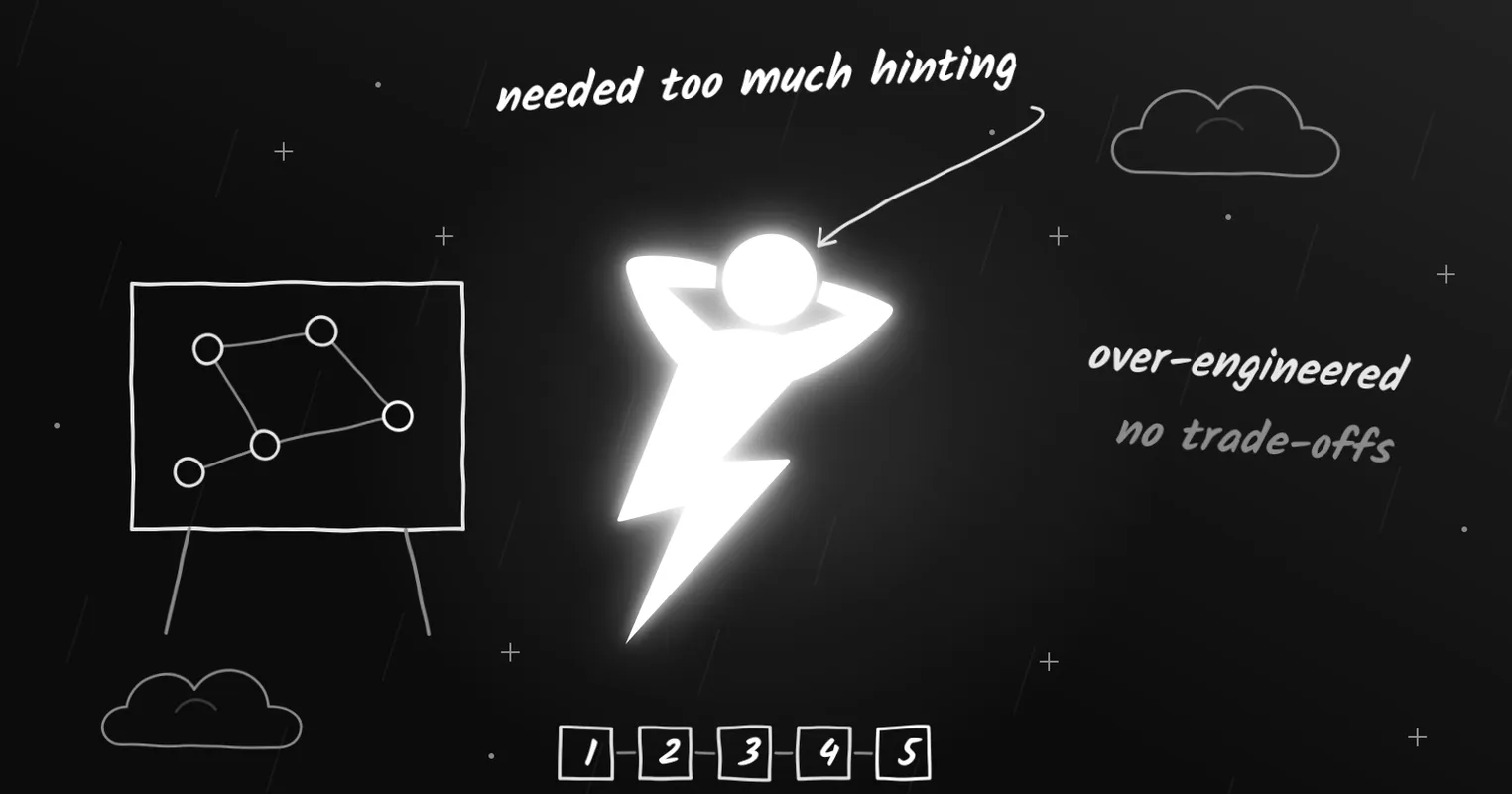
Most rejections from a system design interview (the round where you design a large system such as a news feed out loud on a shared whiteboard) come with no feedback at all. A candidate on Blind describes failing round after round with nothing to learn from (Blind, May 2025). When feedback does come, it is one short phrase from the interviewer’s write-up: “required too much hinting”, “over-engineered”, “no depth”.
Those phrases are a code. Each one maps to a specific behaviour that interviewers see again and again, and each behaviour has a fix you can practise. This post decodes the eight phrases that show up most in rejections and interviewer blogs, with the weak answer and the rewritten answer for every one. At the end there is a flow of where a round usually goes off the rails and the move that gets it back, plus the two things interviewers say they wish candidates knew.
If you want the 45-minute shape of a strong answer first, read the system design interview framework. This post is about what goes wrong inside that shape.
1. “Required too much hinting”
A candidate interviewing at Atlassian in 2025 reports that the written feedback was “i required lots of hinting”, even though they felt they had answered most questions and the interviewer kept prompting mid-answer (Blind, April 2025).
What it means: you waited. After each piece of the design you stopped and let the interviewer choose the next topic. From the interviewer’s seat, every question they had to ask was a hint, and a candidate who needs the next step pointed out at every turn does not look like someone who has built systems. A Meta interviewer who says they have run about a thousand design rounds lists “when I am giving them hints, do they respond well” as a thing they grade (Blind AMA, June 2024). Needing one hint and using it well is fine. Needing ten is the phrase above.
The weak version, after the high-level design is on the board:
Candidate: “So that is the basic design.” (Silence.) Interviewer: “What happens when the database gets slow?” Candidate: “We could add a read replica.” (Silence.) Interviewer: “And if writes are the problem?”
The rewritten version:
Candidate: “That is the basic design, and it covers the scope we agreed. The weakest point is the database: every read and write hits one box. I want to go there first and split reads from writes, then look at the hot-partition problem on writes. Does that order work for you, or would you rather see the feed ranking?”
What to say every time you finish a part: “The next thing I would worry about is X. Want me to go there, or somewhere else?” You keep the pen, and the interviewer still gets to steer.
2. “Over-engineered”
Hello Interview reports that “one of the most common ways to get down-levelled” (hired one level below the level you applied for) “is to over-engineer” (Hello Interview, January 2025). A Google engineer on Blind makes the same point about over-engineering in a thread on whether to do capacity math at all (Blind, June 2025).
What it means: you reached for a technology before the problem asked for it. The Hello Interview post defines it as applying a technique “to a problem where it’s not appropriate”, and gives three reasons it costs you: “You’re almost always missing something” about the tool you named, “the maintenance overhead is huge”, and “more moving parts means more mistakes”. Each extra box is one more thing the interviewer can ask you to defend.
Here is the over-engineered first draft of a news feed that interviewers see several times a week. Three services behind a gateway, Kafka, Cassandra, Elasticsearch, a ranking model service and a data warehouse, drawn in the first ten minutes before anyone has said how many users there are.

And the simple version that passes, for the scope “users post text, follow other users, and read a reverse-chronological feed”:

The simple version is not a toy. It is the shape Twitter described for its home timeline in 2012: posts written once, fanned out by workers into a per-user timeline in memory, each timeline capped at 800 entries, serving about 300,000 timeline reads a second (Raffi Krikorian, QCon 2012). Everything in the first diagram that is not in the second is a deep dive you can add later, if the interviewer asks for it.
The weak version:
Candidate: “I will put an API gateway in front of three microservices: posts, feed and users. Posts go to Cassandra, because we need to shard. Post events go to Kafka, and Elasticsearch handles ranking.” Interviewer: “Why Cassandra?” Candidate: “For scale.”
The rewritten version:
Candidate: “I will start with one API and one relational database for users, follows and posts, plus a queue and workers that write each new post into the followers’ timelines in Redis. That covers the whole scope. If we agree the write volume is high enough, I will come back and split the posts table, but I want to see the number first.”
The Hello Interview post’s advice is to start with “the most basic design that satisfies your functional requirements” and only add parts you can explain the downsides of. That is also the shape the framework post uses: simplest design by minute 20, then depth.
3. “Too high level” or “no depth”
The opposite failure, and the one that catches candidates who memorised a block diagram. A commenter who says they interview at Rippling describes the rule plainly: “if you drew a box and said ‘caching’ but didn’t explain any cache patterns”, that is “enough for us to fail you at that round”, and “an okay solution isn’t enough to pass” at the senior level (Blind, September 2025).
What it means: you named components instead of designing them. “Cache”, “queue”, “load balancer” and “sharding” are nouns. The interviewer wants the verbs: what goes in the cache, when it is written, what happens when it is wrong.
The weak version:
Candidate: “Reads are heavy, so I will add a cache in front of the database.” Interviewer: “How does the cache get filled?” Candidate: “On reads.” Interviewer: “And when a post is edited?” Candidate: “We invalidate it.”
The rewritten version:
Candidate: “Reads are heavy, so I will add a cache-aside cache for post bodies (the application checks the cache first, and on a miss reads the database and writes the result into the cache). Keys are post ids, with a time-to-live of an hour. On an edit, the post service deletes the key, so the next read fills it with the new version. The cost: a short window where two readers can see different versions, and a thundering herd when a popular key expires, which I would handle by letting one request refill the key while the others wait.”
Cache-aside and write-through are the two patterns to know by name (AWS ElastiCache docs), and the “lease” idea for the thundering herd is what Facebook did in memcache (NSDI 2013). You do not need the paper. You need two sentences past the noun. The cheat sheet has the one-line version of each building block and the question to answer about it.
4. “No trade-offs” or “could not commit”
At staff level, Hello Interview says the most common pattern it sees in failed mocks is a candidate who “kept falling into this trap of outlining options for major decisions” without choosing, and the advice is blunt: “Make the decision. Don’t just outline options.” (Hello Interview, staff-level guide). Meta’s rubric for the design round grades a competency called Solution Design, which its guides describe as balancing “trade offs between performance, scalability, maintainability, and cost” (Hello Interview Meta guide).
What it means: one of two things. Either you never said what you gave up (every choice looks free in your telling), or you listed three options and asked the interviewer to pick. Both read as someone who has not had to live with a decision.
The weak version:
Interviewer: “SQL or a document store for the posts?” Candidate: “Both could work. SQL gives us transactions, a document store scales writes better, it depends on the requirements. What do you usually use here?”
The rewritten version:
Candidate: “PostgreSQL. Posts and follows are relational, we need a transaction when a user deletes their account and all their posts, and at our write rate one primary with replicas is enough. The cost is that past a few thousand writes a second I would have to partition the posts table by user id, which is more work than it would be in a store that shards on its own. I accept that because we are not near that number.”
The shape is: choice, reason, cost, why the cost is acceptable. The Hello Interview staff post adds that you should justify “but don’t attempt to make an airtight case”. One cost, named, beats five hedges. For the numbers that make “we are not near that number” true, see back-of-the-envelope estimation: a managed PostgreSQL instance on 4 virtual CPUs handled about 4,700 to 6,200 mixed transactions a second in a 2025 benchmark (ClickHouse, 2025).
5. “Did not drive the conversation”
Meta’s own interview guide lists “Drive the discussion” as the first thing it wants from candidates in the 45-minute design round (Meta careers). An engineer who writes about failing more than ten design rounds puts “Letting the interviewer drive the interview” as their first lesson: “it made me seem unsure, unstructured, and junior” (Hemant Pandey, June 2025). Their next three lessons are related: missing subtle interviewer hints, not writing or drawing enough, and jumping into components too early.
What it means: this is phrase 1 seen from further back. “Hinting” is about the next step. “Driving” is about the whole hour. A candidate who drives announces the plan, keeps a visible list of what is left, and re-budgets time out loud when the interviewer adds something.
The weak version, at minute two:
Candidate: “Should I start with requirements, or do you want me to go straight to the design?” Interviewer: “Up to you.” Candidate: “OK. So, what scale are we talking about?”
The rewritten version:
Candidate: “Here is how I will use the time. Five minutes on scope, then one number to size the system, then the simplest design that works by about minute twenty, then I go deep on the two hardest parts, and I keep five minutes at the end for trade-offs. Interrupt me anywhere. First, scope: I assume text posts, follows, and a reverse-chronological feed, no ranking and no media. Is any of that wrong?”
Then keep a short list on the board: scope, number, design, deep dive 1, deep dive 2, trade-offs. Tick each one. When the interviewer adds a requirement, write it on the list and say where it will fit. The framework post has the three moves for when the question changes halfway.
6. “The numbers did not match the design”
interviewing.io’s guide on latency describes the pattern: candidates write something like “p99 latency < 10ms” on the whiteboard before they know what the system does, and then “the latency requirement is long forgotten” (interviewing.io, November 2026). (p99 is the time within which 99 out of 100 requests finish. It is the number that matters for the slow tail, not the average.) The same post gives the mismatch in one line: a 10 ms p99 budget and a multi-region synchronous database commit “cannot coexist”.
What it means: you wrote a number as a ritual, then designed as if you had not. Every number on the board is a promise the drawing has to keep. A 10 ms budget rules out a cross-region write, because a round trip from California to the Netherlands is about 150 ms, and even a round trip inside one data centre costs about half a millisecond (Jeff Dean’s latency numbers).
The weak version:
Candidate: “Non-functional requirements: p99 under 10 milliseconds, 99.99% available.” (Twenty minutes later.) “Writes go to the primary in one region and replicate synchronously to the other region before we acknowledge, so we never lose a post.”
The rewritten version:
Candidate: “I will set the feed read budget at 200 milliseconds at p99, which feels instant on a phone. Writes can be slower, say a second, because the user just sees their own post appear. That split lets me replicate writes across regions asynchronously, which costs me a short window where a post is not yet visible everywhere. I accept that for a feed.”
interviewing.io’s method is three steps: do the math, rule out what will not fit, name the trade-off you are accepting. If you are not going to use a number, do not write it. If you write it, point at it whenever you add a box, and say whether the box fits inside it. The calculation habit that interviewer Calvin Barker asks for is the same idea: calculations “should always directly influence your design” (Calvin Barker, December 2025).
7. “Followed a script”
Jacob Brazeal, an interviewer writing in November 2025, says that candidates “will spend fifteen minutes painfully enumerating APIs and database schemas before addressing the core problem, if they even get that far” (Jacob Brazeal, November 2025). Brazeal names the cause: treating a seven-step framework like a prayer to be recited, right down to drawing a box labelled “API gateway” because the template has one. Barker sees the other half: when they cut a section short, “usually the API design”, candidates feel “a minor panic that the interview isn’t going exactly to plan” (Calvin Barker).
What it means: the framework became the answer instead of the scaffolding for one. Brazeal’s two questions are the fix. “What am I being asked?” and “What is interesting about this problem?” For a news feed, the interesting part is fan-out for users with millions of followers. For a chat app, it is ordering and delivery. For a payment system, it is never charging twice. The APIs and schema exist to serve that part, so write only the ones the interesting part needs.
The weak version:
Candidate: “Step three, API design. POST /users, GET /users/{id}, PUT /users/{id}, DELETE /users/{id}, POST /posts, GET /posts/{id}…” Interviewer: “Let’s skip the rest of the APIs. How do you build the feed?” Candidate: “Sure. Um. Let me finish the schema first, then I will get to that.”
The rewritten version:
Candidate: “The interesting part of a feed is fan-out: one post from a user with ten million followers has to land in ten million timelines. So the two APIs that matter are POST /posts and GET /feed, and the table that matters is follows. I will write those three, skip the rest, and spend the time on how a post reaches a follower’s feed.”
A framework is a clock, not a script. The framework post is written that way on purpose: each step has a time box and a reason, and the time boxes move when the interviewer moves them.
8. “Add a cache for everything”
Two Hacker News threads from interviewers describe the same tell. One, who has interviewed many candidates on performance questions, says there are “lots of candidates whose only answer to those is ‘add a cache’”, with “scale up” as the second most common answer, and that after hints like “what can be done with the database itself” the conversation goes nowhere (Hacker News, March 2025). Another, who says they have done hundreds of design interviews, calls it “pretty fun” to watch mid-level engineers slowly realise “not every problem can be solved by caching” (Hacker News, August 2025).
What it means: you have one tool. A cache helps when the same data is read many times and can be a little stale. It does nothing for writes, for data that is read once, for data that must be exact, or for a slow query that is slow because of a missing index.
The weak version:
Interviewer: “The booking confirmation query is slow at peak.” Candidate: “Add a cache.” Interviewer: “The data changes every second and must be exact.” Candidate: “Then a shorter cache. Or we scale up the database.”
The rewritten version:
Candidate: “First I want to know why it is slow. If it is a missing index on booking id, an index fixes it and no cache is needed. If it is lock contention because reads and writes hit the same rows, I move reads to a replica. If it is that confirmations are built from five tables, I precompute the confirmation row when the booking is written. A cache is the wrong tool here because the data must be exact.”
The same August 2025 commenter adds a point that cuts the other way: the simple, unscaled answers “are the answers we are looking for” at the start, and complexity is layered on later. A cache is one of those layers, not the first move. The cheat sheet lists the scaling moves in the order to reach for them: index, replica, partition, cache, queue.
Where a round goes off the rails, and the recovery at each point
The eight phrases cluster at five moments in the 45 minutes. Here is the flow, with the move that gets the round back at each point.

- Drawing before the scope is agreed (minute 0 to 5). Produces “over-engineered” and “followed a script”. Recovery: stop, say the scope in three lines, ask what is wrong. Thirty seconds.
- No complete picture by minute 20. Produces “too high level” later, because you never got to depth. The interviewer in the Blind AMA targets the basic design finished by the midpoint, with about 40% of the time spent getting there (Blind AMA, June 2024). Recovery: cut the API list, draw the smallest design that works, walk one request through it.
- Silence after the high-level design. Produces “required too much hinting” and “did not drive”. Recovery: name the weakest box and go there yourself.
- The interviewer asks “why not X?” Produces “no trade-offs” if you fold, and “over-engineered” if you add X to please them. Recovery: pick one option, say its cost, keep moving. Changing your mind is fine if you say why.
- Minute 38 with no summary. Produces “could not commit”. Recovery: four sentences, choice, cost, what you cut, what comes next.
What interviewers wish you knew
Two things come up in interviewer write-ups that no candidate feedback phrase covers, because candidates rarely get far enough to be told.
Queue and worker patterns. An interviewer on Hacker News in 2026 says the biggest gap they see is that candidates “lack context on how to architect pub/sub or queue-worker driven patterns” (Hacker News, January 2026). (Pub/sub is publish and subscribe: one part of the system announces an event, and any number of other parts receive it. Queue-worker means a buffer of jobs with a pool of processes pulling from it.) Almost every design that passes has one of these in it: the fan-out in the feed above, the delivery workers in a notification system, the webhook retries in a payment system. Know the four properties to say out loud: the queue holds work until a worker is free, so the API returns at once; delivery is at-least-once, so workers must handle duplicates; order holds within one partition only (Kafka docs); and permanent failures go to a dead-letter queue a human can inspect.
Cost as a requirement. Calvin Barker’s post has a section titled “Skipping the most important nonfunctional requirement of all: making money”, with the line that a system’s “ultimate goal should be to enable profits” (Calvin Barker). You do not need a price list. You need to notice when a choice is expensive and say so: “storing every version of every photo forever costs more than the product earns, so I would move old versions to cold storage after 90 days.” Object storage prices make this concrete: about $0.023 per gigabyte-month on S3 Standard in the US East region (AWS) against about $0.007 on Backblaze B2 (Backblaze).
Barker’s other two notes are worth taping to the monitor. “I want to hear your voice”, not a recited template, and “it’s a positive signal to me if a candidate recognizes the limits of their knowledge”. Saying “I have not run Cassandra in production, so I would want to check how it handles this” beats guessing. The junior engineer’s guide covers what you are allowed not to know at each level.
One caution about the phrases
Interviewers disagree with each other. In the same Hacker News thread quoted above, one candidate reports two rounds for similar roles where one interviewer marked them down for not adding a data warehouse and the other said the cache made the design too complex (Hacker News, August 2025). Some of what you were told is about the interviewer, not you. But the eight phrases above are the ones that repeat across companies and years, which is why they are worth fixing first.
Practise the fixes, not the phrases
Each fix is a habit, and habits only form by doing the round out loud. Take one question from the 20 system design interview questions, set a 45-minute timer, and pick one phrase from this list to defend against. Run the news feed and check you drew the simple diagram first. Run a rate limiter and check every number you wrote was used. Run Instagram and check you named a cost for every choice. Then do the same question again a week later with a different phrase.
How InterviewStorm helps
InterviewStorm is a practice partner for the design round, and the fastest way to see which of the eight phrases your answer would earn. Describe the question in a mock call and it gives back a complete answer to compare against: the requirements to clarify, the number that matters, an architecture diagram it draws itself, the request flow, the schema and APIs, the scaling moves, and the trade-offs with their costs. Put your own diagram next to its simple one and the over-engineering is easy to see. See the system design feature.
Most companies do not allow AI help during the design round itself, and interviewers say they watch for it. Use it where the employer allows it, and to practise everywhere else. Follow each employer’s interview rules. Do not use InterviewStorm in proctored tests, exams, or anywhere AI help is not allowed.
The free trial is 20 minutes in total, up to 15 minutes per session, with no credit card. Try it free.
For the rest of the loop, read the guides on coding interviews and the STAR method.
Share Articles:
Similar Posts