System Design Interview for Junior Engineers: What to Expect
- Andrew C. Lewis
- 12 Nov, 2026
- 14 Mins read
Most system design guides are written for senior engineers. They assume you have run a database at scale, know why a partition key matters, and can argue about consensus protocols. If you are one to three years in, that is not where you are, and the good news is that nobody grading you expects it to be.
This post covers what a junior system design interview (the round where you design a small application out loud on a shared whiteboard) actually looks like: whether you will get one at all, what you are graded on, what you are allowed not to know, the five questions juniors get most, and one full worked answer to “design a simple ticket booking app” in the 45-minute shape. It ends with a four-week plan built from the other posts in this series.
Do juniors get this round at all?
It depends on the company and the level, and the answer has changed as companies have published their loops.
- Google. Hello Interview’s guide to the L4 loop (early career) says “there’s no dedicated system design round at L4” and that “Google reserves system design for L5 and above”. Design topics show “up briefly inside a coding round, not as its own interview” (Hello Interview, Google L4 guide). At L5 it is a 45-minute round on a virtual whiteboard or Google Docs (Hello Interview, Google L5 guide).
- Meta. E4 (the level after new grad) is “the first Meta level that includes a dedicated design interview”, and “the behavioral and design rounds carry the most weight for level determination at E4” (Hello Interview, Meta E4 guide). Product-track candidates get a Product Architecture interview and infrastructure candidates get a System Design interview. The difference between the two is covered in product design vs system design interviews.
- Amazon. For L4 (SDE I), “the design interview covers object oriented design instead of large scale systems” (Hello Interview, Amazon L4 guide). From SDE II, Amazon’s own page says to “expect at least one question on software systems design” inside a loop of four 55-minute interviews (amazon.jobs).
- Everyone else. Smaller companies and mid-sized startups often give a lighter version of the round to every engineering level, sometimes as a 30-minute conversation about a feature rather than a 45-minute whiteboard session. Ask the recruiter. The question “is there a design round, and what level is it pitched at?” is normal and expected.
So the honest answer: at new-grad level you will usually not get a full system design round at the big companies. One level up, you often will, and it may decide your level.
What a junior is actually graded on
A Meta design interviewer who says they have run about a thousand rounds drew the line between the two levels in a Blind AMA. E4 candidates “can break down design into components” and “get a simplistic but complete solution”. E5 candidates “should be able to do deep dives and tradeoffs”, and handling scalability and failure cases “is also required” at that level. On failure cases at E4, they say: “might be OK. Becomes a bit tough when someone starts asking about failure modes” (Blind AMA, June 2024).
Read that again, because it is the whole rubric for a junior round. Complete and simple beats partial and clever. Translated into what the interviewer writes down:
- Requirements. Did you ask what the system has to do and for how many people, and write it down, before drawing?
- A complete simple design. Is there a client, a server, a database, and does every feature in the scope have a path through the drawing?
- The data model. Can you name the tables (or collections) and the fields that matter, and say which record points at which?
- One or two trade-offs. Can you name one choice you made and what it cost you? One is enough. Two is good.
- Responding to hints. The same interviewer lists “when I am giving them hints, do they respond well” as a thing they grade. Juniors are expected to need hints. The grade is on what you do with them.
What is not on the list: capacity math beyond one rough number, sharding, replication strategies, consensus, caching patterns, and anything with “distributed” in the name. If you reach for them anyway, you risk the most common senior-level failure, over-engineering, which Hello Interview names as “one of the most common ways to get down-levelled” (Hello Interview, January 2025). At junior level it looks worse, because you cannot defend the parts you added.
What you are allowed not to know
Interviewer Calvin Barker, writing about hundreds of rounds, says “it’s a positive signal to me if a candidate recognizes the limits of their knowledge” (Calvin Barker, December 2025). At junior level, these are the things you can say “I have not done this in production” about without losing a point, as long as you can say what the thing is for:
- Sharding (splitting one large table across several database servers). Know that it exists and that it is what you do when one database cannot hold the writes. You do not need to know how to pick a shard key.
- Consensus and leader election (how a group of servers agrees on one value or one leader when some of them crash). Know the names Raft and ZooKeeper exist (raft.github.io). Nobody expects you to explain them.
- Exact numbers. You should know that a day has about 86,400 seconds (call it 100,000 for mental math) and that a single relational database handles thousands of transactions a second, not millions. You do not need the latency table. The back-of-the-envelope post has the numbers if you want them, but a junior round rarely asks for more than one.
- Cache patterns, consistent hashing, CAP. Know what a cache is for (serving repeated reads from memory instead of the database). The patterns are a senior-level topic.
What you are not allowed not to know: what a database transaction is, what an index is for, why the API should not wait for an email to be sent, and how a client talks to a server. Those come up in every junior round.
The five questions juniors get most
These are the prompts that show up at junior level, each with the one thing it is really testing. The 20 system design interview questions post has fuller outlines for each.
- A URL shortener. Tests whether you can design a key, a lookup, and a redirect. The one decision: a 301 redirect is cached by the browser, so you lose click counts, while a 302 is not (MDN).
- A simple notification or email service. Tests whether you know to put a queue between the API and the slow email provider. The framework post walks this one through the whole 45 minutes.
- A to-do app or a booking app. Tests the data model and one tricky write. The worked answer below is this one.
- A basic chat. Tests whether you know the difference between the client asking the server for new messages every few seconds (polling) and the server pushing them over an open connection (a WebSocket, MDN).
- A file upload service. Tests whether you put the file in object storage (a service built for large files, such as S3) and only the file’s metadata in the database, and whether the upload goes straight to storage instead of through your server.
If you only have time for two, do the booking app and the notification service. Between them they cover the data model, the transaction, the queue, and the “what happens when it fails” question that every other prompt builds on.
Worked answer: design a simple ticket booking app
The prompt: “Design a system where users can see upcoming events, pick a seat, and pay for it.” Here is a junior-level answer in the five-step shape from the framework post, with what to say at each step. The time boxes are for a 45-minute round. If yours is 30 minutes, shrink each one by a third and skip the second deep dive.
Step 1: Requirements and scope (0 to 5 minutes)
What to say: “Let me check what is in scope. Users browse events, see which seats are free, hold a seat, pay, and get a confirmation. One event at a time, assigned seats, no waiting room, no refunds. For scale, I will assume a mid-sized ticketing site: say ten thousand events listed at once with a thousand seats each, and a normal day of a few bookings a second, with busier moments when a popular event goes on sale. The hard requirement is that two people must never buy the same seat. Is any of that wrong?”
Write the scope as five lines on the board. Notice the last sentence: you named the hard part in the first five minutes, which is what the interviewer is waiting to hear.
Step 2: The one number that matters (5 to 8 minutes)
At junior level you need one number, and it should be the one that tells you whether a single database is enough.
What to say: “Ten thousand events times a thousand seats is ten million seat rows. That fits in one relational database easily. On an ordinary day a few bookings a second is nothing. The number that worries me is the on-sale moment, when thousands of people press ‘book’ on the same event in the same minute. I will design for the normal case and come back to that moment as a deep dive.”
For reference, a managed PostgreSQL instance on 4 virtual CPUs handled about 4,700 to 6,200 mixed read-write transactions a second in a 2025 benchmark (ClickHouse, 2025). A few bookings a second is three orders of magnitude below that. You can say “one database is fine” with confidence.
Step 3: High-level design and one request (8 to 20 minutes)
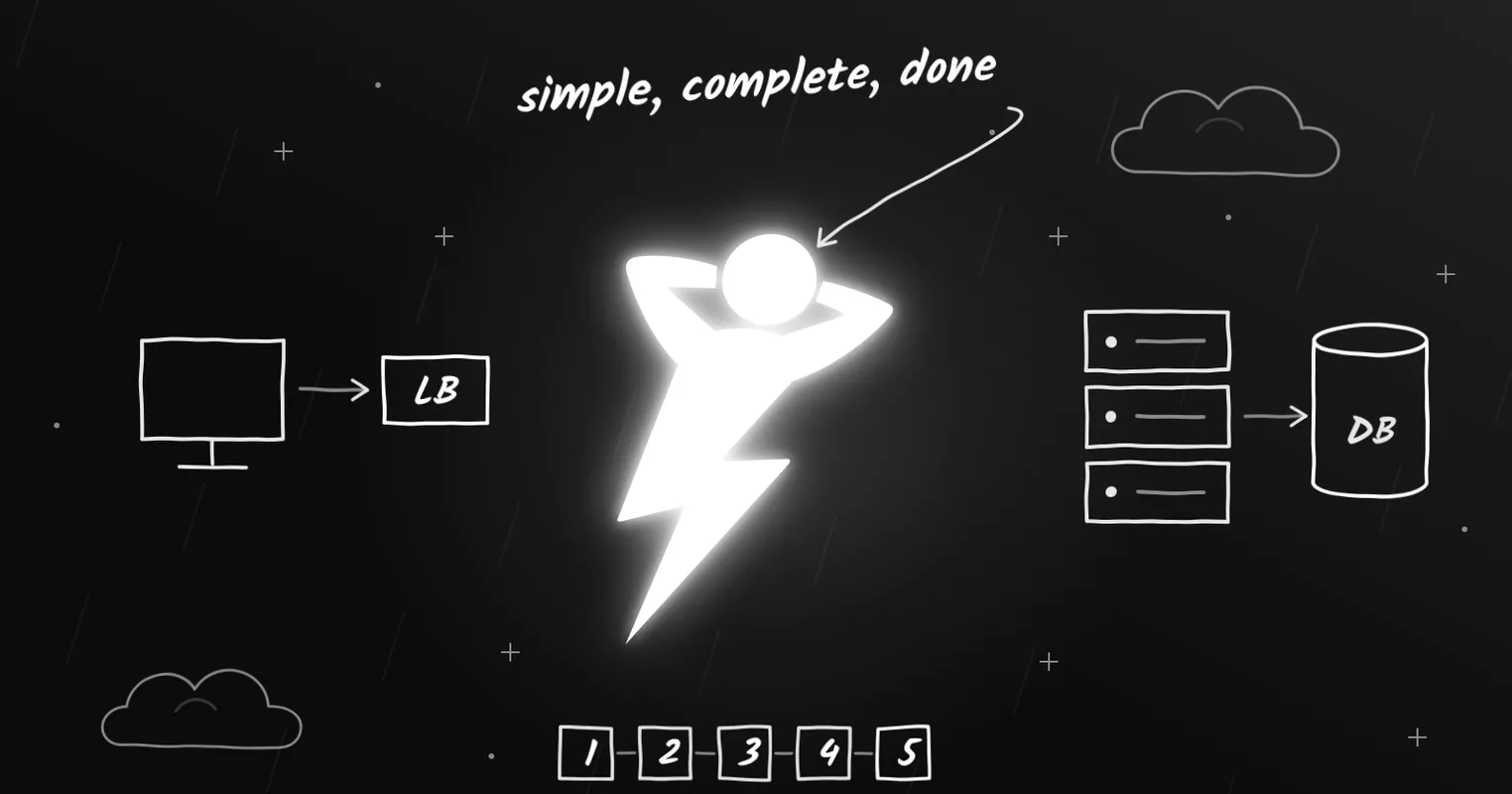
Draw the smallest thing that covers the scope.

The parts, in the order you draw them:
- Client. Web or mobile. It calls three endpoints: list events, list the seats for an event with their status, and create a booking.
- Load balancer (a server that spreads incoming requests across several identical servers). Lets you run three API servers instead of one, so one crashing does not take the site down (AWS).
- Booking API. Stateless, meaning any server can handle any request, because everything that matters lives in the database.
- One relational database. Users, events, seats, bookings. Relational because a booking touches two tables at once and must either fully happen or fully not happen, and that is exactly what a transaction (a group of database changes that succeed or fail together) gives you (PostgreSQL docs).
- Payment provider. You do not build card processing. The API calls Stripe or an equivalent.
- Queue and email worker. Sending the confirmation email is slow and can fail. The API drops a message on a queue (a buffer that holds work until a worker is free) and returns at once. A worker sends the email later.
Now the data model, as boxes:

What to say: “Four tables. Users. Events with a name, a venue and a start time. Seats, one row per seat per event, with a price, a status that is available, held or sold, and a held_until time. Bookings, one row per attempt, pointing at a user and a seat, with a status that is pending, confirmed or expired. The seat’s status is the source of truth for whether it can be sold. I will add an index on seats by event id, because ‘show me the seats for this event’ is the most common read.”
Then walk one booking through the design, out loud:
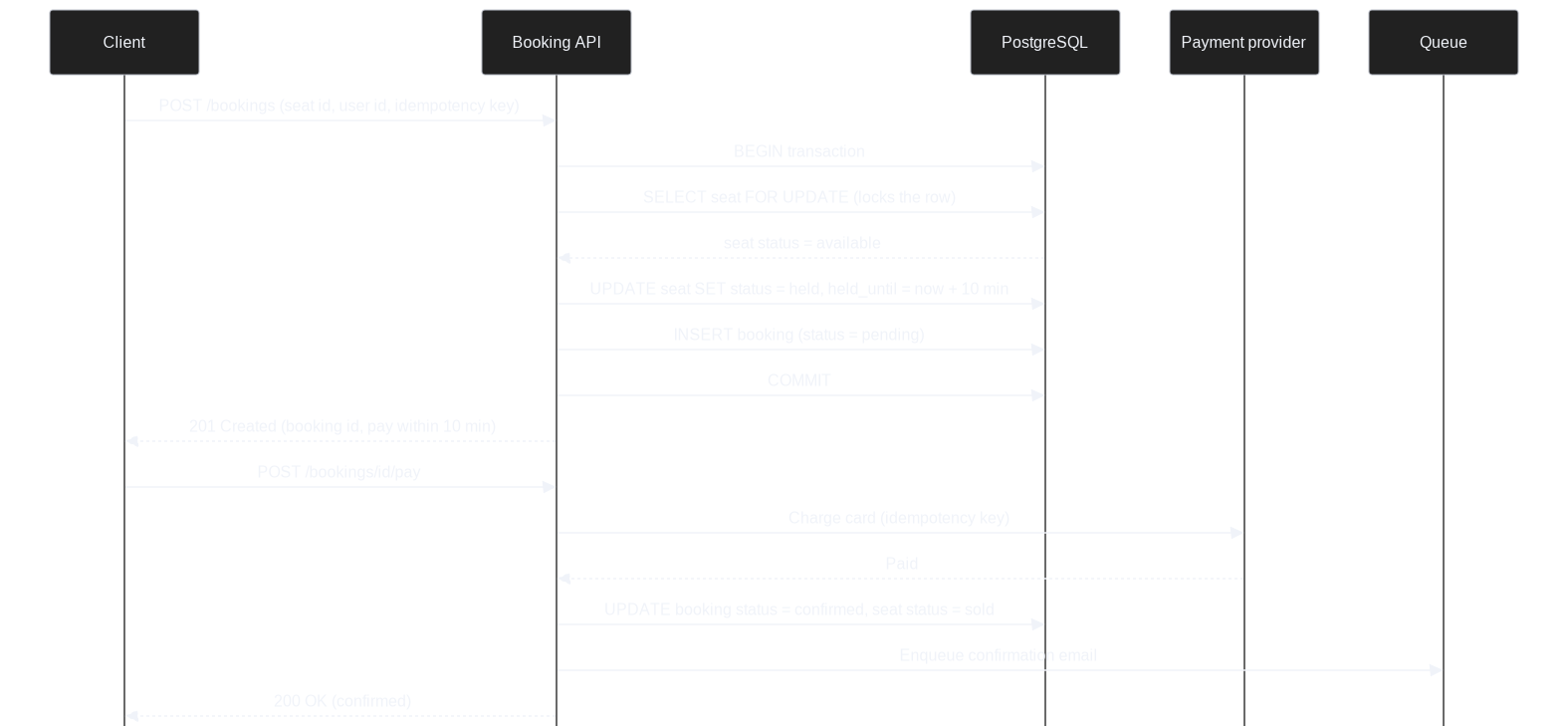
What to say: “The client posts a booking for seat 1234. The API opens a transaction, locks that seat’s row, checks it is available, marks it held for ten minutes, inserts a pending booking, and commits. The client gets a booking id and ten minutes to pay. It calls pay, the API charges the card through the provider, marks the booking confirmed and the seat sold, drops a message on the queue for the email, and returns. If the user never pays, a small job runs every minute and frees seats whose hold has expired.”
You have a complete design and one request traced by minute 20. For a junior round that is most of the grade. Stop and ask: “Does this cover what you had in mind, or is there a flow you want me to trace?”
Step 4: One deep dive, double booking (20 to 33 minutes)
The interviewer will ask the question you set up in step 1: “What if two people click the same seat at the same moment?” This is the deep dive, and at junior level one good deep dive is enough.
The problem, plainly: two API servers each read the seat, both see “available”, both write “held”. Without protection, both users get a confirmation for the same chair.
The fix, in two layers:
- A row lock inside a transaction. When the API reads the seat it asks the database to lock that one row until the transaction ends (in PostgreSQL that is
SELECT ... FOR UPDATE, PostgreSQL docs). The second request arrives, tries to lock the same row, and waits. When the first transaction commits, the second one sees the seat is now “held” and returns “seat taken”. Only one of them can win, because the database only lets one of them hold the lock. - A database rule as the backstop. Add a constraint that a seat can have at most one booking that is not expired. Even if some future code path forgets the lock, the database refuses the second insert.
What to say: “I will lock the seat row when I read it, inside the transaction. The second request blocks until the first commits, then sees the seat is held and gets a ‘seat taken’ response. As a backstop I add a uniqueness rule in the database so a second active booking for the same seat can never be inserted, even if some code forgets the lock. The cost: during an on-sale rush, thousands of requests queue up on the same few rows, so the database is briefly the bottleneck. For a mid-sized site I accept that, because correctness matters more here than a few hundred milliseconds.”
Two things to know about this answer. First, it is the simplest correct answer, and the interviewer knows it. Ticketmaster’s real system puts a waiting room in front of the booking flow because the on-sale rush is extreme: the Taylor Swift presale in November 2022 drew 3.5 billion requests, four times the previous peak (Ticketmaster, November 2022). You can mention that as “what a very large site does” without designing it. Second, the idempotency key in the sequence (a unique id the client sends with the request, so a retry of the same request does not create a second booking or a second charge) is the same idea Stripe uses for its API (Stripe). Mentioning it is a small signal that you have thought about retries, and it costs one sentence.
If there is time for a second deep dive, take the expired holds: a job every minute that sets status = available where status = held and held_until < now(), and what happens if the payment succeeds at the same moment the hold expires (check the hold inside the pay transaction, and refund if it already expired).
Step 5: Trade-offs and what you cut (33 to 40 minutes)
What to say: “I chose one relational database because a booking has to update two tables together and I need a lock, and at this size one database is plenty. The cost is that it is a single point of failure, so I would run a replica to fail over to. I used a queue for emails so the booking does not wait on the email provider; the cost is that a confirmation can arrive a minute late. I cut refunds, the waiting room, and general-admission tickets. With more time I would look at the on-sale rush, which is where this design strains first.”
Four sentences: choice and cost, choice and cost, what you cut, what comes next. Then stop.
Wrap up (40 to 45 minutes)
Ask one real question: “How does the team here handle the on-sale moment?” You will learn something, and it shows you were designing for their world.
”What if it gets 100 times more users?”
This is the follow-up juniors fear most, and it is usually a kindness: the interviewer is giving you a chance to show one or two scaling ideas without demanding a senior answer. The trick is to say what breaks first, then fix only that.
What to say: “A hundred times more users means a hundred times more reads of the event and seat lists, and maybe a hundred times more bookings. The API servers are stateless, so I add more behind the load balancer; that part is easy. The database is what breaks. Reads break first, because browsing is far more common than buying, so I add read replicas (copies of the database that serve reads while the primary takes the writes, PostgreSQL docs) and point the event list and seat map at them. If writes also outgrow one primary, the next step is splitting the data by event, since bookings for one event never touch another. I have not done that split in production, so I would want to read up before choosing how.”
That last sentence is the one Barker calls a positive signal. You named the next move and admitted its edge. Do not go further unless asked. The interviewer who asks “how would you shard it?” after that has moved you to a senior question, and “I would partition by event id, since every booking belongs to exactly one event” is a complete junior-level reply.
Three things not to say: “add a cache” as the first move (interviewers on Hacker News describe this as the most common and weakest answer, Hacker News, March 2025); “use a NoSQL database” without a reason; and “microservices”. Each invites a follow-up you cannot win. The mistakes post has the full list of answers that earn bad feedback.
A four-week prep plan
Four weeks, about five hours a week, built from the posts in this series. Each week ends with one mock round out loud, with a timer, drawing in a whiteboard tool.
Week 1: the shape and the words.
- Read the system design interview framework and copy the clock onto an index card.
- Read the cheat sheet. Make sure you can explain, in one plain sentence each, what these are for: load balancer, relational database, index, transaction, queue, cache, object storage, WebSocket.
- Mock: the notification service from the framework post, 45 minutes, out loud.
Week 2: data models and the one tricky write.
- Redo the booking app above from memory. Draw the four tables first, then the design, then the sequence.
- Do a to-do app and a URL shortener the same way. Each one has a data model and one decision; find it and say it.
- Mock: the booking app, with a friend playing the interviewer and asking “what if two people pick the same seat?” and “what if it gets 100 times more users?”
Week 3: the two patterns juniors miss.
- Queues and workers: an interviewer on Hacker News says the biggest gap they see is candidates who “lack context on how to architect pub/sub or queue-worker driven patterns” (Hacker News, January 2026). Design a file upload service and an email service, and put the slow part behind a queue in each.
- Real-time: design a basic chat, once with polling and once with WebSockets, and say the cost of each.
- Mock: pick one of the 20 questions marked junior and run the clock.
Week 4: feedback and the full loop.
- Read the mistakes post and pick the two phrases most likely to apply to you. For most juniors they are “required too much hinting” and “too high level”. Rerun one mock defending against each.
- Read back-of-the-envelope estimation once, for the handful of numbers, not the method.
- Spend the rest of the week on the rounds that carry more weight at your level: coding interviews and behavioral questions with the STAR method.
If you are interviewing at Meta on the product track, add one hour on product design vs system design, because the Product Architecture round starts from the user and the API rather than from the infrastructure.
How InterviewStorm helps
InterviewStorm works as a practice partner for a junior design round, where the hard part is knowing what “complete” looks like. Describe the prompt in a mock call and it gives back the full shape of an answer at this level: the requirements to clarify, the one number that matters, an architecture diagram it draws itself, the request flow, the schema and APIs, the scaling moves in order, and the trade-offs to name. Compare it with your own drawing and you can see which table or which step you left out. See the system design feature.
Most companies do not allow AI help during the design round itself, and interviewers say they watch for it. Use it where the employer allows it, and to practise everywhere else. Follow each employer’s interview rules. Do not use InterviewStorm in proctored tests, exams, or anywhere AI help is not allowed.
The free trial is 20 minutes in total, up to 15 minutes per session, with no credit card. Try it free.
Share Articles:
Similar Posts