TCS Interview Process: NQT, Technical, Managerial, and HR Rounds
- Andrew C. Lewis
- 11 Oct, 2026
- 06 Mins read
Tata Consultancy Services (TCS) is one of the biggest employers of engineers in India. Every year, a very large number of freshers apply through campus and off-campus drives, and many experienced people apply for lateral roles (jobs for people who already have work experience).
The process is well known and fairly stable. If you understand each step, you can prepare for it on purpose instead of guessing. This guide covers how it usually works for freshers and for experienced candidates, the questions that come up most, and how to prepare.
Details change from drive to drive. Always read the official notice on the TCS careers site and your registration emails. They are the final word.
The TCS process at a glance
For freshers, most candidates go through these steps:
- Register on TCS NextStep. NextStep is the TCS careers portal for campus and fresher hiring. You create a profile, fill in your academic details, and apply for the drive.
- Take the TCS NQT. NQT stands for National Qualifier Test. It is the written test that decides who gets an interview.
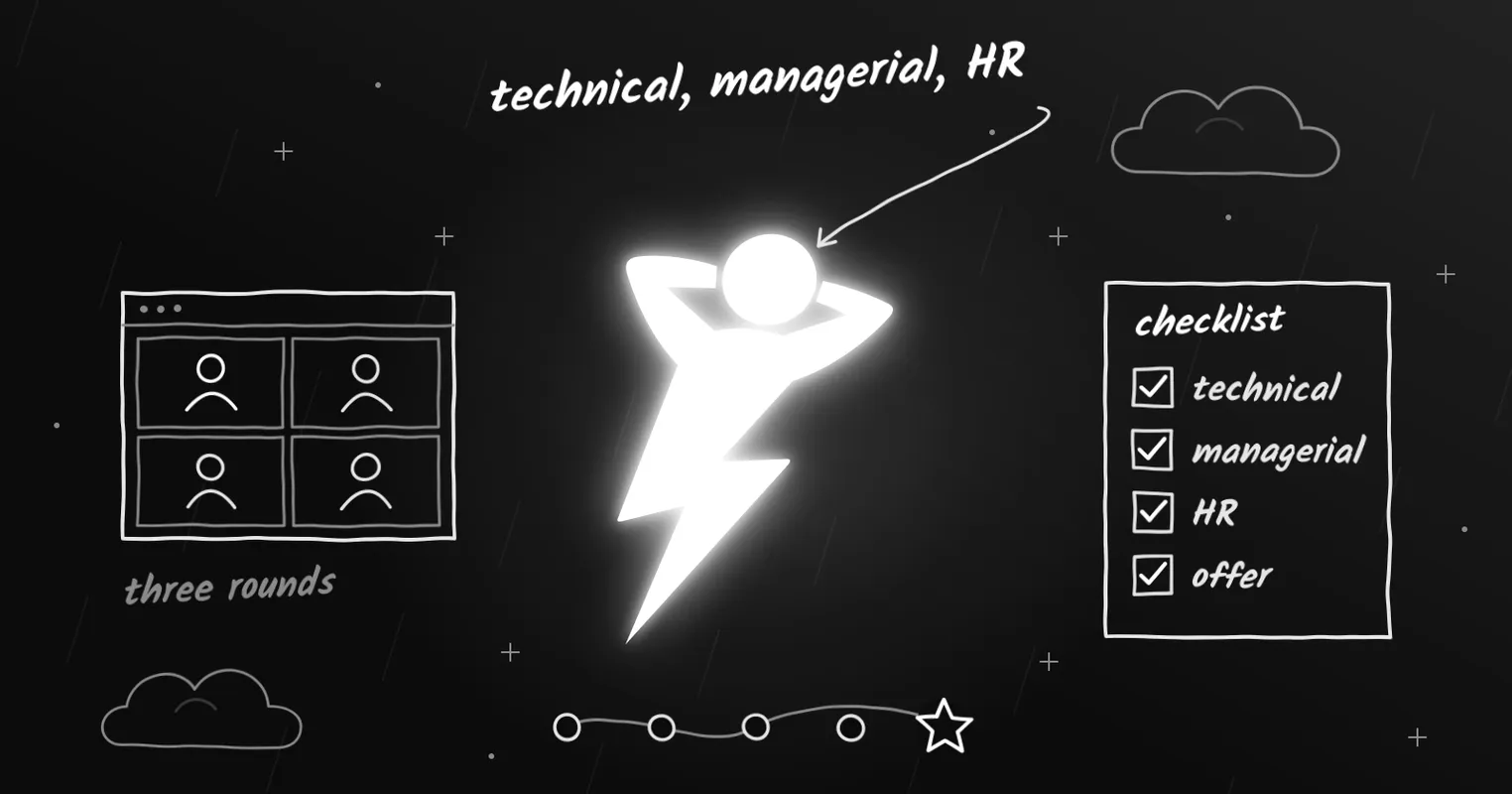
- Interview. Usually a technical round, a managerial round (often called MR), and an HR round. Sometimes these happen in one sitting with a panel, sometimes one after another.
- Offer and joining. Selected candidates get an offer letter, then document checks and onboarding.
For experienced candidates, there is usually no NQT. You apply for a specific role, and the process moves to technical and managerial discussions, then HR.
Step 1: TCS NQT (prep only)
TCS describes the NQT as one integrated test for its three fresher categories: Ninja, Digital, and Prime. You take a single test, and your performance decides which interview you are called for. Ninja is the standard track. Digital and Prime are higher tracks with tougher coding expectations.
Recent drives used two parts:
- Foundation section: numerical ability, verbal ability, and reasoning ability.
- Advanced section: advanced quantitative and reasoning questions, plus coding problems.
Prep sites that track the test report a total time of around three hours, with coding taking the largest share of the Advanced section. Exact question counts and timings change between drives, so check the pattern in your own admit card or notice.
The NQT is a proctored exam. That means it is monitored, usually at a TCS iON exam centre or with remote monitoring. Do not use any AI tool, phone, or outside help during it. Breaking the rules can get you disqualified. The only way through is real preparation.
How to prepare for the NQT
- Start with the Foundation section. Speed matters. Practice percentages, ratios, time and work, number series, and seating arrangements with a timer running.
- Read every day for verbal. Reading comprehension and sentence correction improve with steady practice, not last-minute cramming.
- Practice coding in one language. Pick C++, Java, or Python and solve easy to medium problems on arrays, strings, and basic math. Get used to reading input and printing output exactly as the question asks.
- Take full mock tests. Sit for the whole duration in one go. It trains your focus and shows which section eats your time.
- Check your system early if your drive is remote. Test your webcam, browser, and internet a day before.
Step 2: Technical interview
The technical round checks your basics and how well you know your own resume. For freshers, interviewers usually start with your projects and then move to core subjects.
Expect questions on:
- Your final-year project: what it does, your exact role, the tech stack, and one problem you solved.
- Programming basics: the language you listed, with simple programs like reversing a string or checking a prime number.
- OOP concepts: classes, objects, inheritance, polymorphism, encapsulation, and abstraction.
- DBMS and SQL: keys, normalization, joins, and writing a simple query.
- Operating systems and networks: processes and threads, deadlock, and the OSI model, at a basic level.
For Digital and Prime interviews, expect more depth: harder coding questions, data structures, and sometimes basic design questions.
Tip: Do not list anything on your resume that you cannot explain. Interviewers often pick a skill from your resume and ask you to go deeper.
Step 3: Managerial round (MR)
The managerial round checks how you think and behave at work. The interviewer is often a senior person who wants to know if you can handle pressure, clients, and teamwork.
Common MR questions:
- Tell me about a time you worked in a team and there was a conflict.
- What would you do if you could not finish a task before the deadline?
- How would you handle a client who is unhappy with your work?
- Are you comfortable working in any technology TCS assigns you?
- Describe a mistake you made and what you learned.
Answer with a short real story. The STAR method (Situation, Task, Action, Result) keeps your story clear. College projects, internships, and events you organised all count as examples.
Step 4: HR interview
The HR round checks fit, attitude, and practical things like location and documents. It is usually the shortest round, but people still fail it by giving careless answers.
Common TCS HR questions:
- Tell me about yourself.
- Why do you want to join TCS?
- Are you willing to relocate to any city in India?
- Are you comfortable working in shifts?
- Are you planning higher studies?
- Do you have any questions for us?
For freshers, the HR round may also cover the service agreement, if your drive has one. Read the terms in your offer documents and answer honestly. Our full list of HR interview questions for freshers has sample answers for each of these.
Experienced (lateral) hiring at TCS
Experienced hiring is role-specific. Most candidates apply through the TCS careers portal, a referral, a job site, or a walk-in drive. A typical flow looks like this:
- Recruiter screening: your current role, skills, notice period, current CTC (cost to company, your total yearly pay), and expected CTC.
- Technical rounds: one or two rounds on your main skill, your current project, and scenario questions. Some roles add an online assessment first.
- Managerial round: how you handle deadlines, escalations, and team work.
- HR round: salary discussion, joining date, and document checks.
For experienced roles, your current project matters most. Be ready to draw its architecture, explain your exact part in it, and talk about one production issue you fixed.
Common TCS technical questions
These come up often in reported TCS interviews. Prepare a short, clear answer for each:
- What is the difference between C and C++? Between Java and Python?
- Explain the four pillars of OOP with a simple example.
- What is the difference between an abstract class and an interface?
- What is normalization? Explain 1NF, 2NF, and 3NF.
- Write a SQL query to find the second highest salary in a table.
- What is the difference between a process and a thread?
- What is a deadlock, and how can you prevent it?
- Write a program to check if a string is a palindrome.
Tips that help in every round
- Know your resume line by line. Most questions come from it.
- Speak slowly and clearly. On a video call, a calm pace also helps when the connection is weak.
- Say “I do not know” when you do not know. Then say how you would find out. Guessing wildly hurts more than admitting a gap.
- Keep documents ready: mark sheets, ID proof, and your NextStep reference number.
- Prepare two questions to ask at the end, such as what training new joiners get.
- Test your setup before a video interview. Our video interview setup guide covers camera, audio, and internet checks.
Where InterviewStorm fits
InterviewStorm is a real-time AI interview assistant. It hears the question, shows it as live text, and suggests a short answer built from your own resume and the job post.
Use it to practice. Run a practice call with a friend on Microsoft Teams, Zoom, or Google Meet, let them ask the TCS questions above, and see how strong answers from your own projects sound. You can also use it in live interviews where AI help is allowed.
Unlimited is $30, a one-time payment for a month of unlimited use, with no subscription. For the local price and payment options in India, email support@interviewstorm.com. See the InterviewStorm India page for details, or try a free 20-minute trial.
Use it the right way: never use AI help during the TCS NQT or any other proctored online test, or in any interview where the employer does not allow it. Check the rules of every round and follow them.
More India interview guides
Share Articles:
Similar Posts